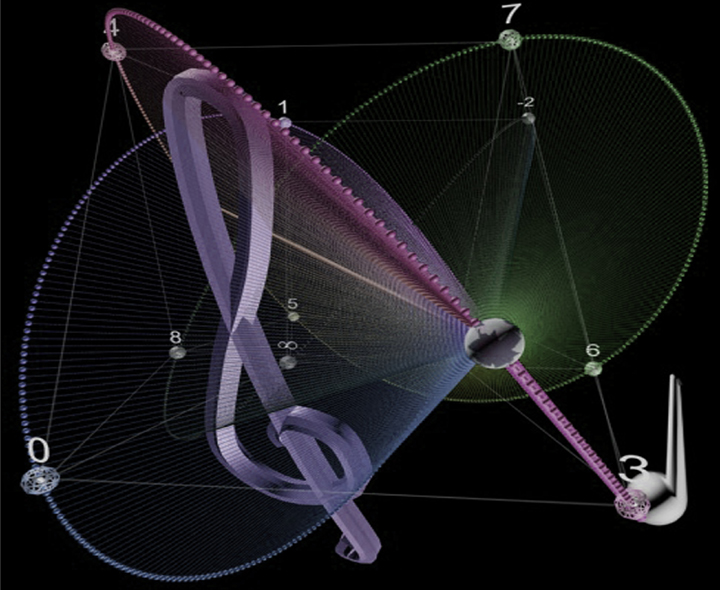
Twelve colored spheres arranged in a perfect circle, surrounding you. Each one is a note. Each one has its own color — red, orange, yellow, green, blue, violet, and the shades between. Walk toward any sphere and you hear its note. Walk away and it fades.
This is Newton's Circle. The simplest space in the museum. The most ancient idea: that the twelve notes of music form a circle, like the hours on a clock.
The colors were chosen by Isaac Newton himself, three centuries ago. He believed that the spectrum of light and the scale of music shared the same hidden mathematics. In this room, you can hear what he saw.
Walk slowly. Listen. The chromatic scale unfolds around you — twelve points of color, twelve points of sound, equally spaced, perfectly arranged. The beginning of the museum, and the beginning of music.
Newton's Circle is the chromatic clock — the twelve pitch classes of Western music arranged at the twelve hour positions of a circle. C at 12 o'clock, C♯ at 1 o'clock, D at 2 o'clock, and so on around to B at 11 o'clock, returning to C.
This circular arrangement reflects a deep mathematical truth: pitch classes are cyclic. Going up by twelve semitones brings you back to where you started — the same note, one octave higher. In pitch-class space, that octave is collapsed. Only the twelve distinct pitch classes remain, arranged in a circle.
Each sphere carries a Newton color — Isaac Newton's chromatic 12-color system. In his Opticks (1704), Newton proposed that the visible spectrum and the diatonic scale shared a common mathematical structure. He mapped seven prismatic colors to seven notes. The full 12-color extension used in MmvM was developed in collaboration with Charles Giulioli to cover all twelve chromatic pitch classes.
The colors are not decoration. They are a notation system. Each pitch class has its color throughout the entire museum. When you see a red sphere in Newton's Circle, in the Tonnetz, in Planet 4D, in any other room — it is the same pitch class, every time.
The sound is spatial. Each sphere radiates its tone from its physical position. A hearing radius around you controls what is audible — approach a sphere to hear it clearly, walk away and it fades. You can adjust the hearing radius if you want to hear more notes at once.
The notes are rendered as Shepard tones — sounds with no fixed octave, cycling endlessly. A pitch class has no octave; a Shepard tone has no octave. The match is honest.
In this room: walk slowly around the circle. Approach each sphere. Listen. Then stand in the middle and turn — let the chromatic scale circle around you.
The chromatic circle — mathematical structure
The chromatic circle is the cyclic group Z₁₂ — the integers modulo 12. The twelve pitch classes are labeled 0 through 11, corresponding to C through B. The group operation is addition mod 12, which corresponds musically to transposition by semitones.
This cyclic structure is the foundation of every other model in the museum. The Tonnetz, the Torus of Thirds, Planet 4D, the Cube Dance, and the Octatonic Tesseract are all built on Z₁₂. Newton's Circle is the simplest visualization — the chromatic clock itself, with no additional structure.
Newton's color theory
Isaac Newton's 1704 Opticks proposed a correspondence between the seven prismatic colors and the seven notes of the diatonic scale (Westfall, 1980). Newton's seven colors were red, orange, yellow, green, blue, indigo, and violet. The mapping to notes was a deliberate choice based on his belief in the unity of physical and musical proportions.
The 12-color extension used throughout MmvM was developed by Gilles Baroin in collaboration with Charles Giulioli (painter) and is documented in Baroin (2011). The extension preserves Newton's spectral logic while filling in the five chromatic notes that the seven-color system did not address.
The Newton color system is used consistently across all scenes that display individual pitch classes — Newton's Circle, the Tonnetz, the Torus, Planet 4D, the Cube Dance, the Möbius Strip, the Octatonic Tesseract, the CubeHarmonic, and Scene 14.
Shepard tones — the honest sonic representation
Pitch classes have no inherent octave. The pitch class C represents every C across every octave — there is no specific frequency. To sonify a pitch class honestly, the sound itself must have no octave.
Shepard tones are the natural solution. A Shepard tone is constructed by superimposing sine waves at multiple octaves of the target pitch class, with amplitudes shaped by a bell curve that suppresses the extreme high and low frequencies. The result is a sound that has a clear pitch class but no defined octave — it cycles endlessly through pitch space, mirroring the cyclic structure of Z₁₂.
The use of Shepard tones for pitch-class sonification across MmvM is a design decision by Gilles Baroin, validated through collaboration with Richard Cohn.
Spatial sound and hearing radius
Each sphere is an audio source at its position in 3D space. The visitor's position determines what is heard — closer spheres are louder, farther spheres are softer. The exact attenuation is shaped by a hearing radius parameter that the visitor can adjust.
This mechanism — spatial sound with hearing radius — is the foundation of the sonic experience in Newton's Circle, the Tonnetz, the Torus, Planet 4D, the Cube Dance, the Möbius Strip, the Entangled Hyperspheres, and Fourier Phases 4D. Only the scenes that use stereo sound (Scene 7, Scene 9, Scene 11) deviate from this pattern.
Further reading
- Baroin, G. (2011). PhD thesis, Université de Toulouse. https://theses.hal.science/tel-00943407v1
- Newton, I. (1704). Opticks. London.
- Westfall, R. S. (1980). Never at Rest: A Biography of Isaac Newton. Cambridge University Press.
- Jewanski, J. (1999). Is there a relation between music and colour? Leonardo, 32(4), 321–326.
Credits
- Isaac Newton (1704) — original color-music correspondence
- Charles Giulioli — co-creator of the Newton 12-color system extension (with Baroin)