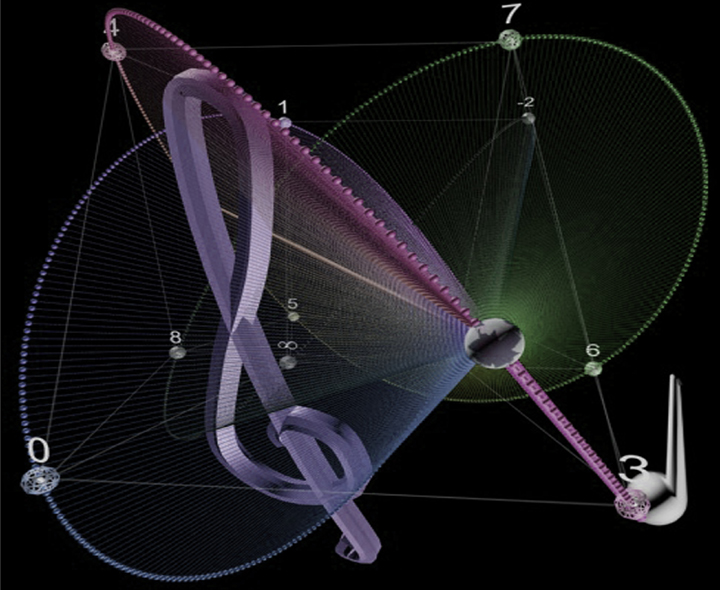
A vast hexagonal mesh stretches out around you, on the ground, in every direction. Each cell is a triangle. Each triangle is a chord. Each line between triangles is a single voice movement — one note, one step.
Walk across the lattice. The triads sing as you approach them. A major chord glows on one side of an edge; a minor chord glows on the other. Cross the edge and the harmony shifts by the smallest possible motion. One note moves. Two stay.
This is the Tonnetz — the network of tones. It was first drawn by Euler in 1739, refined by Riemann a century later, and rediscovered by modern theorists as the natural geometric home of triadic harmony. Every major and minor chord in Western music lives somewhere on this mesh.
You are walking on the inside of harmony itself.
The Tonnetz — German for "network of tones" — is a geometric representation of the relationships between musical notes and chords. It was first drawn by Leonhard Euler in his Tentamen novae theoriae musicae (1739) and developed further by Hugo Riemann in the late 19th century. Modern music theorists — most notably Richard Cohn and Julian Hook — have refined and extended it into a central tool of neo-Riemannian theory.
The hexagonal version used in MmvM is Julian Hook's representation. Each triangle is a triad. Each edge between triangles represents a single-note voice-leading movement: one note moves by a semitone or whole tone, the other two notes stay. These are the P, L, and R transformations — Parallel (major↔minor sharing root and fifth), Leading-tone (major↔minor sharing third and fifth), and Relative (major↔minor sharing third and root).
The lattice extends infinitely. In MmvM, you walk on it as you would on a vast tiled floor. Each triangle radiates the sound of its triad. Approach a triangle and the chord becomes louder. Walk across an edge and the harmony shifts parsimoniously to the next chord.
The Planet-4D ideographic symbols also appear on the Tonnetz. Each triangle is marked by a colored, shaped symbol indicating its chord type and root. Once you know the system from Newton's Circle (Scene 1), every chord is identifiable at a glance.
Demo mode: Press the demo button and a MIDI song begins to play. The chord progression of the song is detected in real time, and a marker travels across the Tonnetz to the current chord. The song was analyzed using a chord recognition system producing JSON timecode files (with Gonzalo). The visitor sees the harmonic path of a real piece traced through the lattice.
In this room: walk slowly. Each step changes the harmony. Cross an edge in any direction — the chord that emerges is the closest possible relative of the chord you just left.
Historical foundations
The Tonnetz originated with Leonhard Euler (Tentamen novae theoriae musicae, 1739), who arranged the just-intonation pitch classes on a two-dimensional grid generated by the intervals of the perfect fifth and major third. Arthur von Oettingen (1866) and Hugo Riemann (late 19th century) developed Euler's grid into a tool for harmonic analysis, refining the spatial relationships between triads and their voice-leading neighbors.
The 20th century neo-Riemannian theorists — including David Lewin (1987), Brian Hyer (1995), Richard Cohn (1996, 1997), and Julian Hook (2002, 2023) — reformulated the Tonnetz as a graph of voice-leading relations among triads. The vertices are pitch classes; the edges are intervals; the triangular faces are major and minor triads. Each edge between two triangles encodes a single-voice parsimonious transformation.
The three neo-Riemannian transformations
The Tonnetz makes three fundamental triadic transformations visible as edge-crossings:
- P (Parallel) — major ↔ minor sharing root and fifth. C major ↔ C minor. The third moves by a semitone.
- L (Leading-tone) — major ↔ minor sharing third and fifth. C major ↔ E minor. The root moves by a semitone.
- R (Relative) — major ↔ minor sharing third and root. C major ↔ A minor. The fifth moves by a whole tone.
These three transformations generate the full PLR-group acting on the 24 major and minor triads. Repeated application of any single transformation cycles through a hexatonic, octatonic, or whole-tone subgroup.
Julian Hook's hexagonal representation
The MmvM Tonnetz uses the hexagonal representation developed by Julian Hook. The original Euler-Riemann grid uses parallelograms; Hook's hexagonal version uses equilateral triangles, which preserves the symmetry of the P, L, R transformations and makes voice-leading distance directly visible as Euclidean distance.
Reference: Hook, J. — specific hexagonal Tonnetz paper, cited in Baroin (2011).
The chord recognition system
The demo mode uses a chord recognition system that analyzes MIDI files and produces JSON timecode files indicating the chord at each moment. The system was developed in collaboration with Gonzalo [surname TBD]. The Tonnetz follower in MmvM reads these JSON files and positions the current-chord marker accordingly.
Future development
The Tonnetz family in MmvM extends beyond the basic hexagonal version. The Geode (Scene 6) contains films of related models — the Polarized Tonnetz, the SpinnenTonnetz, and the Shadow Tonnetz. These extensions have not yet been implemented as interactive scenes, but they exist as research and as films.
Further reading
- Euler, L. (1739). Tentamen novae theoriae musicae. St. Petersburg.
- Riemann, H. (1880). Skizze einer neuen Methode der Harmonielehre.
- Cohn, R. (1996). Maximally Smooth Cycles, Hexatonic Systems, and the Analysis of Late-Romantic Triadic Progressions. Music Analysis, 15(1), 9–40.
- Cohn, R. (1997). Neo-Riemannian Operations, Parsimonious Trichords, and Their Tonnetz Representations. Journal of Music Theory, 41(1), 1–66.
- Hook, J. (2023). Exploring Musical Spaces. Oxford University Press.
- Lewin, D. (1987). Generalized Musical Intervals and Transformations. Yale University Press.
- Baroin, G. (2011). PhD thesis, Université de Toulouse.
Credits
- Leonhard Euler (1739) — original Tonnetz
- Hugo Riemann — 19th-century development
- Julian Hook — hexagonal Tonnetz representation
- Richard Cohn (Yale University) — neo-Riemannian theory, hexatonic systems
- Gonzalo [surname TBD] — MIDI chord recognition system