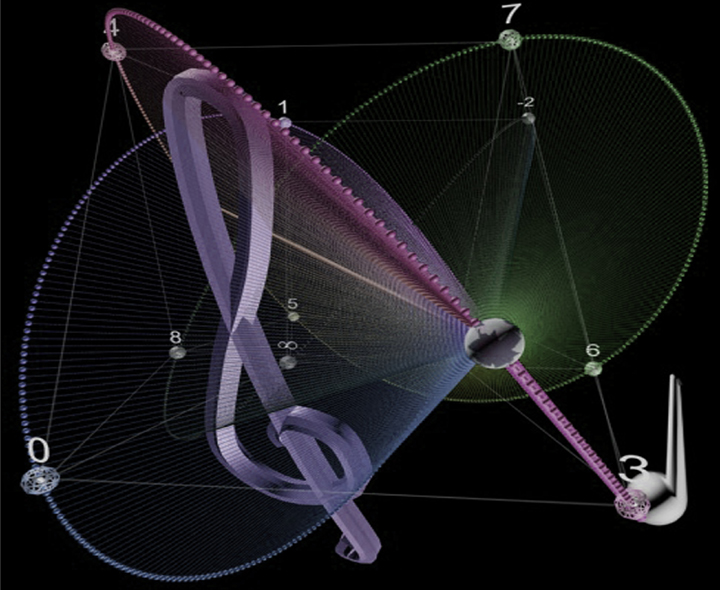
Twelve colored symbols, woven into a hyperspherical web of harmonic lines. A sphere that is not quite a sphere — transparent, geometrical, alive with hidden connections. The lines between the symbols trace the harmonic relationships of Western music: this note leads to that one, this chord resolves to the next. The whole of tonal harmony, held in a single object you can fly through.
Reach for the controls and spin it. You don't need to understand anything yet. Just watch what happens.
The symbols slide and glide over each other. Circles cross circles. The geometry of harmony unfolds before you, dimension by dimension, moment by moment. You cannot see four dimensions. But you can feel them — in the way this object moves, deforms, reveals itself.
A still hypersphere is a shadow. A moving one is alive.
Fly around it. Go inside it. Let it turn.
—
A transparent sphere turns before you — covered in twelve colored symbols, connected by a web of lines tracing every harmonic relationship in Western music. Each symbol is a note. Each line is a harmonic relationship. The web you are looking at is the Tonnetz — the same network of musical connections you may have walked in the previous rooms — but now drawn on the surface of a four-dimensional hypersphere.
This is Planet 4D. A mathematical model that places the twelve pitch classes on the surface of S³ — the four-dimensional equivalent of a sphere — so that every note is perfectly equidistant from its neighbors. The symmetry is exact. Every note has the same relationship to the whole as every other note. No distortions, no compromises.
The sphere carries the Planet-4D ideographic symbols — four shapes for the augmented-triad family, four colors for the diminished-seventh family, twelve unique notes formed by their pairing. Notes are small; chords are large, light for major and dark for minor. Only notes produce sound, radiating spatially around you. Stand between three notes and their tones overlap in your hearing radius — the chord emerges acoustically.
But to truly perceive a 4D object in our 3D world, you must set it in motion. A static projection shows only one frozen shadow of a richer reality. Animate it — rotate it along its two axes — and the full structure reveals itself, dimension by dimension.
The rotation is musically meaningful. Rotate along one axis and the major thirds cycle before you. Rotate along the other and the minor thirds cycle. Choose the right combination of speeds and the chromatic scale revolves. Choose another and the circle of fifths appears. The rotation is not decoration — it is navigation through harmonic space.
Four ways to explore — all open to every visitor:
Rotation mode. Reach for the controls and spin it. Set the hypersphere turning at your chosen speed along both axes. Watch the harmony reveal itself in motion. This is where most visitors begin — and it is exactly the right place to start.
Fly freely. Approach notes, discover chords through sound and position. Go inside the sphere, above it, through it. Expand or shrink your hearing radius.
MIDI song mode. Start a song and the hypersphere rotates automatically, driven by the music — always presenting the current chord at your fixed user spot. Look up at the sky screen for a bird's eye view of the current position on the model.
Pilot mode. Navigate to a specific note or chord, or move one step along a harmonic relationship. The hypersphere rotates to bring your destination to you.
Seven display modes sit on top of the model — seven ways to look at the same hypersphere. They live on the side panel as seven buttons (Notes · Chicken · Cohn · JQZ on the top row; Chords · CubeDance · Bigo below), named after the music-theory object each one shows. A short info line beneath the active button names the model and its creator. The next section walks through them.
In this room: spin it first. Then fly inside it. Then start a song and let the music drive the rotation. The model rewards every kind of attention.
—
The mathematical construction
Planet 4D places the twelve pitch classes as quaternions on the 3-sphere S³. Each pitch class is assigned a unit quaternion q = (z₁, z₂), where:
- z₁ = e^(iα) — a unit complex number encoding the note's position in its augmented triad family. α takes 3 values, spaced 2π/3 apart, corresponding to movement by a major third (4 semitones).
- z₂ = e^(iθ) — a unit complex number encoding the note's position in its diminished seventh family. θ takes 4 values, spaced π/2 apart, corresponding to movement by a minor third (3 semitones).
The two complex coordinates are perpendicular, and |q| = 1 — the quaternion lies on the unit 3-sphere. The radii of the two coordinate circles are set to 1/√3 and 1/√4 respectively, ensuring that harmonically equidistant notes are also physically equidistant on the surface.
The construction can also be stated in graph theory terms: Planet 4D is the Cartesian product C₃ × C₄ of two cycle graphs — C₃ for the augmented triad family and C₄ for the diminished seventh family.
The ideographic system as a Gaussian integer
The Planet-4D ideographic system — shape encoding the augmented family, color encoding the diminished family — is the visual representation of the same quaternionic structure. Each symbol corresponds to a Gaussian integer z = a + bi, where:
- a (real part) = shape = position in C₃
- b (imaginary part) = color = position in C₄
The visual notation and the mathematical model are two faces of the same structure.
Difference from the classical Tonnetz
The classical Tonnetz of Riemann and Cohn is generated by the perfect fifth and the major third. Planet 4D is generated by the major third and the minor third — the two intervals that define triadic harmony directly. This returns to the spirit of Euler's 1739 Tonnetz, which also used thirds rather than fifths.
The necessity of animation
A stereographic projection of S³ into R³ gives a faithful but necessarily incomplete picture. Any static projection shows one frozen cross-section of a richer structure. To perceive the full geometry, the object must be animated — rotated through its 4D axes α and θ.
Rotation along α cycles through the augmented family. Rotation along θ cycles through the diminished family. Specific speed combinations make the chromatic scale or the circle of fifths visible as a continuous revolving motion.
New symmetries — with Emmanuel Amiot
Beyond the standard T/I group, the hyperspherical environment of Planet 4D reveals additional isometries. With Emmanuel Amiot, the M5 and M7 operations (pitch-class multiplication by 5 or 7) were identified as geometric symmetries of S³ — operations that preserve the hyperspherical structure but have no natural geometric expression in lower-dimensional models.
Reference: Amiot, E., & Baroin, G. (2015). Looking at old and new isometries between pc-sets in the Planet-4D Model. Music Theory Online, 21(3).
Display modes
The seven modes share the same model — the Planet 4D hypersphere — and reveal different layers of harmonic structure on it. Most of them are lifts from the rich two-dimensional tradition of Tonnetz visualization: Hook, Douthett and Steinbach, Cohn, Jedrzejewski, Bigo. Each is brought up to four dimensions and rendered here, preserving the music theory and adding the hyperspherical symmetries.
A short info line in the GUI names the active mode and credits its originator.
Notes
Planet-4D ideographic system — Gilles Baroin
The base layer. Twelve note-planets sit on the hypersphere, each a unique pairing of one of four shapes (augmented-triad family) and one of four colors (diminished-seventh family). This is the ideographic system from the PhD thesis — the visual notation of the C₃ × C₄ structure. With this mode alone, the hypersphere reads as a colored constellation of twelve symbols and nothing else: pure pitch-class space, no chords, no edges.
Chords
Planet-4D Chords — Gilles Baroin · Hamiltonian paths: Giovanni Albini
The 24 chord ideograms — 12 major triads and 12 minor triads — appear at their geometric positions on the hypersphere. Major chords are light, minor chords dark; both carry the same shape-and-color encoding as the notes that form them. The Hypersphere of Chords extends the Planet 4D vocabulary from individual pitches to triads. Giovanni Albini discovered Hamiltonian paths through this network — chord progressions that visit all 24 triads exactly once before returning home, with each transition changing exactly one voice; one of his Hamiltonian compositions is used as a demo here.
Chicken Wire
Chicken Wire — inspired by Julian Hook's hexagonal Tonnetz
The PLR (Parallel / Leading-tone / Relative) connections drawn as a wireframe skeleton on the hypersphere. The hexagonal Tonnetz of Julian Hook — a clean, flat reading of triadic voice-leading — is here wrapped onto S³, so that every chord sits at a node and every parsimonious one-voice move is an edge. The result is a transparent cage of harmonic relationships that you can fly through.
Cube Dance
Cube Dance — Jack Douthett & Peter Steinbach · video work with Moreno Andreatta
The Cube Dance overlay highlights the parsimonious voice-leading graph of Jack Douthett and Peter Steinbach (Parsimonious Graphs, 1998), drawn this time on the hypersphere: the 24 major and minor triads plus the 4 augmented triads, connected by every single-semitone voice change. The augmented triads — corners where all three Newton families meet — render in white, the visual mark of their tri-color sum. Moreno Andreatta — a long-standing friend and foundational collaborator at the start of his evolution in mathemusical work — composed The Gunner's Hamiltonian Dream, a Hamiltonian arrangement of Pink Floyd's The Gunner's Dream; the video animation shared with Scene 5 is the result of that joint work.
Hexatonic Regions
Cohn hexatonic system — Richard Cohn
The four hexatonic regions of Richard Cohn (Maximally Smooth Cycles, 1996) drawn onto the hypersphere. Each region is a six-chord cycle generated by alternating parallel and leading-tone transformations, sweeping through a tightly related family of major and minor triads. On Planet 4D the four hexatonic regions partition the 24 triads into four colored bands, making Cohn's classification visible at a glance.
JQZ
JQZ involutions — Franck Jedrzejewski (2019)
A new mode, mutually exclusive with the PLR / Chicken Wire view. Franck Jedrzejewski (“Non-Contextual JQZ Transformations,” MCM 2019) introduced three pointwise pitch-class inversions — J = I₇, Q = I₁₁, Z = I₄ — each an involution: applying it twice returns the original chord. The three involutions generate a dihedral group D₂₄, isomorphic to the PLR group via the mapping J↔P, Q↔L, Z↔R. Unlike PLR, which acts only on major and minor triads, JQZ is non-contextual and acts on any n-chord. The asymmetry that distinguishes JQZ from PLR is its anti-commutation with transposition: J·Tₙ = T₋ₙ·J. The PLR group commutes with transposition; JQZ does not, and that single algebraic difference gives the mode its distinct musical character.
The visual signature is striking. On entering JQZ mode, the twelve note-planets go fully black — the anti-color sign that each note has become “the note the surrounding chords all avoid.” This is the dual of Scene 5's Cube Dance, where the augmented triads render in white as the sum of all three Newton colors; here, the inverted note is the complement. The P, L, R buttons on the side panel rebind to J, Q, Z, and the chord positions reflect to put each chord's three J/Q/Z partners at its three nearest hexagon-neighbor slots — the same hexagonal topology as PLR, the same edge lengths, but a different harmonic logic.
Generalized Tonnetze
Louis Bigo · Hypersphere of Tonnetze (Baroin × Bigo)
Six chromatic-step Tonnetze, indexed by the step size n: T₁ (semitone), T₂ₐ and T₂ᵦ (the two whole-tone scales — Messiaen's two modes of limited transposition), T₃ (minor-third / diminished-seventh cycle), T₄ (major-third / augmented-triad cycle), T₅ (perfect-fourth cycle). Each Tₙ draws a 12-edge chain around the hypersphere; the visitor can show or hide each chain independently, plus two extra toggles for the note-planets and connecting lines. Default state on entry: T₃ + T₄ + notes ON — the classical Tonnetz layout, augmented triangle plus diminished-seventh cross.
The generalized Tonnetz framework is Louis Bigo's body of work (Bigo, Giavitto, Spicher 2011; Bigo, Andreatta, Giavitto, Michel, Spicher 2013; Bigo & Andreatta 2016). This mode continues the older Hypersphere of Tonnetze — a joint work with Louis Bigo, visible as a film in the Geode (Planet 4D family member #5) — by making the same generalized Tonnetz construction interactive in VR.
The Planet 4D family
Planet 4D is the entry point to a family of eight models:
- Planet-4D (2000/2011) — 12 notes on S³
- Hypersphere of Chords — 24 triads at spherical barycenters
- AnySet Hypersphere — any note aggregate
- Chicken wire — Tonnetz and Cube Dance on S³
- Hypersphere of other Tonnetze (with Louis Bigo) — the predecessor of the Generalized Tonnetze mode above
- Hypersphere of Temperaments (with André Calvet)
- Hypersphere of Spectra (with Stéphane de Gérando)
- The Entangled Hyperspheres (with de Gérando, 2022) → Scene 12
Members 5–7 are not implemented as interactive scenes; films of all are available in the Geode (Scene 6).
Sound
Only note symbols produce sound — spatially. The hearing radius mechanism is identical to Newton's Circle.
Further reading
- Baroin, G. (2011). The Planet-4D Model. MCM 2011, LNCS 6726. Springer.
- Amiot, E., & Baroin, G. (2015). Music Theory Online, 21(3).
- Baroin, G. (2011). PhD thesis, Université de Toulouse.
- Hook, J. (2006). Exploring musical space. Science, 313(5783), 49.
- Douthett, J., & Steinbach, P. (1998). Parsimonious Graphs. Journal of Music Theory, 42(2), 241–263.
- Cohn, R. (1996). Maximally Smooth Cycles. Music Analysis, 15(1), 9–40.
- Jedrzejewski, F. (2019). Non-Contextual JQZ Transformations. MCM 2019, LNCS 11502, pp. 149–160. Springer.
- Bigo, L., Giavitto, J.-L., Spicher, A. (2011). Building topological spaces for musical objects. MCM 2011, LNAI 6726, pp. 13–28.
- Bigo, L., Andreatta, M., Giavitto, J.-L., Michel, O., Spicher, A. (2013). Computation and Visualization of Musical Structures in Chord-Based Simplicial Complexes. MCM 2013, LNCS 7937, pp. 38–51.
- Bigo, L., & Andreatta, M. (2016). Topological Structures in Computer-Aided Music Analysis. In Meredith (ed.), Computational Music Analysis. Springer.
—
Credits
- Gilles Baroin — original Planet-4D model, research since 2000
- Emmanuel Amiot — M5/M7 symmetries
- Giovanni Albini — Hamiltonian paths on the Hypersphere of Chords
- Julian Hook — visual inspiration for the Chicken Wire
- Jack Douthett (†2021) and Peter Steinbach — the Cube Dance
- Moreno Andreatta — The Gunner's Hamiltonian Dream; long-standing friend and foundational collaborator at the start of his evolution
- Richard Cohn (Yale University) — hexatonic regions
- Franck Jedrzejewski — the JQZ involutions (MCM 2019)
- Louis Bigo (CRIStAL / Université de Lille) — Generalized Tonnetze and the joint Hypersphere of Tonnetze (Geode film)
- André Calvet — Hypersphere of Temperaments (family member 6)
- Stéphane de Gérando — Hypersphere of Spectra and Entangled Hyperspheres