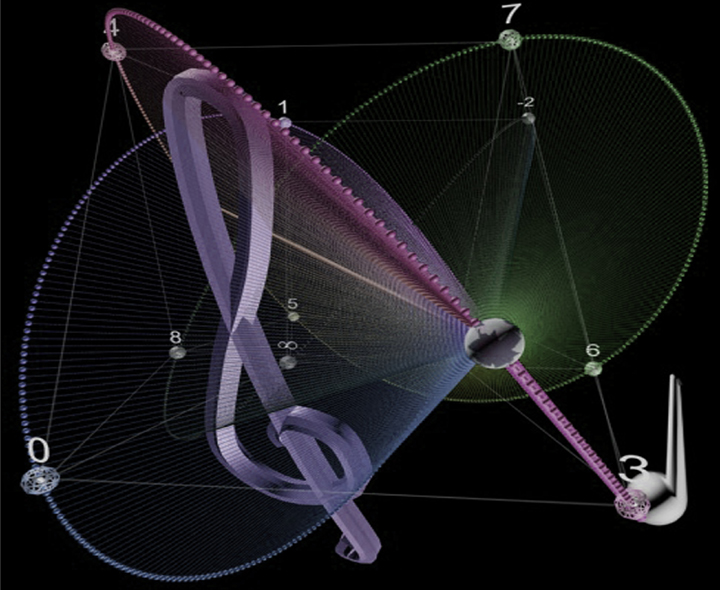
A hypercube, projected into your space.
Like the movie — a cube inside a cube, edges connecting inner to outer, the familiar shape that mathematicians have drawn for centuries. But this one is alive. Rotate it with the sliders and the inner cube swells, the outer shrinks, the edges twist. You are seeing a hypercube from every angle.
At each corner — a chord. Four colored spheres, clustered like a tiny molecule, spinning slowly so you can see all four colors. Move a voice and watch one sphere swap its color while three stay still. The harmony changes by the smallest possible step.
Follow the treble clef as it moves through Wagner’s Tristan und Isolde — harmony that has fascinated musicians for 150 years, now visible as a path through a hypercube.
The structure in this room was discovered by Jack Douthett and Peter Steinbach. In their 1998 paper “Parsimonious Graphs,” they built a model of how seventh chords connect through the smoothest possible voice-leading — one note moving by a single semitone while the other three stay still. They called it the Power Towers, and described it as “the seventh-chord analog to the Cube Dance.” When they refined it to include the French sixth chord, the circuit between two diminished seventh chords became a four-dimensional cube — a tesseract — and they named the full structure the 4-Cube Trio, because it joins three tesseracts the way the Cube Dance joins four cubes.
That is exactly what you are standing in: three tesseracts, linked as a necklace, each pair sharing a diminished seventh chord at its junction.
Each chord occupies a corner of a hypercube. Each edge is a voice-leading step. At the top and bottom of each tesseract sit the diminished seventh chords — the most symmetrical seventh chords, four voices equally spaced by minor thirds. Between them, the chords are arranged by how far they sit from that perfect symmetry. Downward displacement of one voice gives a dominant seventh chord; upward displacement gives a half-diminished seventh chord; further displacements give minor sevenths and French sixths in the middle.
The model has been studied and popularized by several theorists since. Richard Cohn (Yale University) presents it in his forthcoming book Mathemusical Models of Pitch and Time (2027). Dmitri Tymoczko treats seventh-chord voice-leading geometrically in A Geometry of Music (2011), and Julian Hook develops these spaces in Exploring Musical Spaces (2023). But the structure itself is Douthett and Steinbach’s.
Each chord is represented by a tetraquark — a cluster of four small spheres, one per voice, each in its Newton color. This four-sphere representation is Gilles Baroin’s contribution to the model: a way of showing each four-note chord as a single colored object whose four colors you can read at a glance. The spheres spin slowly so all four colors stay visible.
The tetraquarks sound in Shepard tones — sounds with no fixed octave, cycling endlessly, the honest sonic representation of pitch classes. When the follower moves from one chord to the next, exactly one sphere changes color and three stay the same — a conservation law in the spirit of Emmy Noether: the voices that do not move conserve their color. Parsimony becomes visible.
Seeing inside the hypercube. A set of controls lets you read the tesseract’s hidden structure. You can stretch the cube along its C–C♯ dimension to emphasize that one voice’s motion, and switch on translucent cross-section surfaces that reveal a beautiful fact about a 4-cube: slice it from top to bottom and you pass through a point, a tetrahedron, an octahedron, another tetrahedron, and a point.
Watch the treble clef trace the opening of Wagner’s Tristan Prelude — the progression of seventh chords that has fascinated theorists since 1859, now a visible path across three tesseracts.
In this room: rotate the hypercube. Watch the tetraquarks spin. Move a voice and observe which sphere changes. Switch on the cross-section surfaces. Then start the Tristan animation.
Origin — Douthett and Steinbach’s Power Towers and 4-Cube Trio
The structure visualized in this room originates with Jack Douthett and Peter Steinbach, “Parsimonious Graphs: A Study in Parsimony, Contextual Transformations, and Modes of Limited Transposition” (Journal of Music Theory, 42(2), 1998, pp. 241–263). In that paper they introduced a family of parsimonious voice-leading graphs. For triads, the graph is the Cube Dance (Scene 5 of this museum). For seventh chords, the analog is the Power Towers — which the authors describe as “the seventh-chord analog to the Cube Dance.”
Douthett and Steinbach subsequently refined the Power Towers to include the French sixth chord in the appropriate voice-leading zones alongside the minor seventh chords. With that refinement, the circuit of all sets between two diminished seventh chords closes into a tesseract (a 4-cube), and the full graph — which connects three such tesseracts the way the Cube Dance connects four cubes — is what they named the 4-Cube Trio. The “octatonic tesseract” of this scene is one tesseract of that 4-Cube Trio.
This origin matters: the geometry is Douthett and Steinbach’s. The theorists who came later studied, extended, and popularized it, but did not originate it.
The model’s later study and popularization
- Richard Cohn (Yale University) presents and develops this seventh-chord space in Audacious Euphony (Oxford, 2012) and in his forthcoming Mathemusical Models of Pitch and Time (Oxford, ~2027), where Chapter 25 treats the octatonic tesseract. The MmvM scene was developed in collaboration with Cohn for that book.
- Dmitri Tymoczko treats seventh-chord voice-leading as geometry in A Geometry of Music (Oxford, 2011, pp. 284–293), where single-semitone motions produce cross-type transformations among seventh chords.
- Julian Hook develops these musical spaces in Exploring Musical Spaces (Oxford, 2023), and the visual style of the tesseract imaging in MmvM was inspired by Hook’s treatment — first in his 2006 Science article Exploring Musical Space, then in the 2023 book.
The tetraquark visualization — Gilles Baroin
The representation of each four-note chord as a tetraquark — four Newton-colored spheres clustered as a single rotating object — is Gilles Baroin’s contribution to the model. Where Douthett-Steinbach drew chords as labelled nodes, the tetraquark renders each chord’s pitch-class content directly and legibly in color, and makes the conservation law (one voice moves, one sphere changes color) visible at a glance. The same tetraquark system is used in Scene 9 (Orbifolds).
The chords — ME(12,4) and NE(12,4)
The octatonic tesseract models voice-leading among the 16 most even four-note chords in 12-tone pitch-class space, drawn from NE(12,4) — the nearly even chords — together with ME(12,4), the maximally even chords.
ME(12,4) — the three distinct diminished seventh (dim7) chords: {0,3,6,9}, {1,4,7,10}, {2,5,8,11}. Each is a cycle of minor thirds partitioning Z₁₂ into four equal parts.
NE(12,4) — the nearly even chords displace one pitch class of a dim7 chord by one semitone:
- Downward displacement → dominant seventh chords (dom7)
- Upward displacement → half-diminished seventh chords (ø7)
Each dim7 chord is Q-related to 8 nearly even chords: 4 dom7 and 4 ø7.
Structure of a single tesseract
16 vertices, 32 edges, distributed across five levels (levels 6–10 in Cohn’s notation):
- Level 6: 1 dim7 chord (boundary)
- Level 7: 4 dom7 chords (downward displacements)
- Level 8: 6 chords — 4 minor sevenths + 2 French 6th chords
- Level 9: 4 half-diminished chords (upward displacements)
- Level 10: 1 dim7 chord (boundary)
The (1, 4, 6, 4, 1) distribution mirrors the fifth row of Pascal’s triangle. A tesseract contains eight cubes, each defined by one pitch class; the eight defining pitch classes form an octatonic collection — the combination of the two boundary dim7 chords. The octatonic collection in (12,4) plays the structural role the hexatonic collection plays in (12,3) / the Cube Dance.
The diagonal cross-sections — point, tetrahedron, octahedron
The five levels are the geometric cross-sections of the 4-cube taken perpendicular to its main diagonal, the (1,1,1,1) direction. A level is defined by the coordinate-sum along that diagonal: how many of the four pitch-class dimensions are in their “upper” state. Slicing a tesseract this way produces the classic sequence:
point → tetrahedron → octahedron → tetrahedron → point
- The apex (1 chord) and nadir (1 chord) are the two boundary dim7 chords — single points.
- The upper and lower levels (4 chords each) form true 3D tetrahedra — their four vertices are not coplanar.
- The middle level (6 chords) forms a true 3D octahedron — its six vertices are not coplanar; it is not a flat hexagon.
MmvM can display the three middle solids — lower tetrahedron, octahedron, upper tetrahedron — as translucent surfaces with light-gray edges. Each has its own independent show/hide toggle, and surface color and transparency are adjustable. Because the surfaces are built from the projected vertex positions, they follow the cube as it rotates, stretches, and reprojects; the light-gray edges keep each solid legible even when the faces are faint. This is the most tangible way to see a 4-cube’s internal structure — the point–tetra–octa–tetra–point progression made visible as physical strata of chords.
The Stretch control
A Stretch slider elongates the tesseract along its C0–C♯0 dimension — the 4D X axis, corresponding to the first voice flipping C↔C♯ in the octatonic chord set. Range 0.5 to 2.0, default 1.0 (1.0 normal, 2.0 doubled extent, 0.5 compressed). The stretch is applied in the model’s 4D space before projection, so the elongation direction rotates with the cube — it always follows the C0–C♯0 dimension rather than a fixed screen direction. The quark spheres and labels keep their original size; only the structure — vertices, edges, faces — spreads apart. Musically, this emphasizes the C↔C♯ dimension of the chord space.
Three tesseracts — the necklace (the 4-Cube Trio)
Three distinct octatonic collections → three distinct tesseracts. Each pair shares one dim7 chord at their junction. Together: a necklace of three tesseracts — Douthett and Steinbach’s 4-Cube Trio.
45 nodes in MmvM: 24 nodes exclusive + 3 shared dim7 junction nodes (C°7, C♯°7, D°7), each belonging to two tesseracts. Starting position: C°7, accessible to T1 and T3 immediately.
The 4D projection
Each chord node has a 4-bit coordinate (x, y, z, w), each value 0 or 1, mapped to ±1. Neighbors generated by flipping one bit per axis direction (X±, Y±, Z±, W±).
Six-step projection pipeline:
Step 1 — XW rotation (angle α_XW):
x₁ = x·cos(α_XW) − w·sin(α_XW)
w₁ = x·sin(α_XW) + w·cos(α_XW)
Step 2 — YW rotation (angle α_YW, uses w₁):
y₁ = y·cos(α_YW) − w₁·sin(α_YW)
w₂ = y·sin(α_YW) + w₁·cos(α_YW)
Step 3 — ZW rotation (angle α_ZW, uses w₂):
z₁ = z·cos(α_ZW) − w₂·sin(α_ZW)
w₃ = z·sin(α_ZW) + w₂·cos(α_ZW)
Step 4 — Perspective projection (4D → 3D):
factor = e / (e − w₃), where e = projectionFactor
px = x₁·factor, py = y₁·factor, pz = z₁·factor
Steps 5–6: 3D rotations and world scale. The Stretch factor is applied in 4D space before Step 1, so it scales along the model’s own X axis and rotates with the structure.
Two preset orientations: (A) Cohn’s harmonic orientation; (B) traditional tesseract.
The tetraquark representation
Each chord = tetraquark — four small spheres at vertices of a point-up tetrahedron. All quarks are spheres. Newton color identifies pitch class. Four distinct colors per tetraquark in this scene. Cluster rotates on two axes continuously to prevent occlusion; speed parameterable.
A Label Distance slider controls how far above each tetraquark its text label floats — the vertical world-up offset. Range 0 to 2, default 1.25. Useful for decluttering a dense view or bringing labels closer to their nodes. The labels keep their size and continue facing the camera; only their distance from the node changes.
Shepard tones — a systematic sonification choice
Throughout the museum, pitch classes are sonified using Shepard tones — sounds that cycle endlessly through pitch without ever arriving at a higher or lower octave. This makes the heard pitch live on a circle, matching the cyclic geometry of the models. On chord arrival, four Shepard-tone clips play simultaneously, one per pitch class; the previous chord stops first. This systematic use of Shepard tones for pitch-class sonification across an entire mathemusical environment is, to our knowledge, an original contribution of MmvM.
The conservation law — Emmy Noether
Conserved voice = conserved color. Moving voice = changing color. One quark changes per step. Three conserved. Parsimony visible and countable.
Tristan und Isolde — analysis
The opening of Wagner’s Tristan Prelude (1859) is modelled on the necklace of three tesseracts. Three parallel phrases, each starting with a chord leap followed by a chromatic descent.
Phrases 1 and 2: ø7 → dom7, two descending semitones each. Both cross a tesseract boundary through the shared dim7 junction.
Phrase 3: Bass descends (C→B), three voices ascend by semitone each. Net motion: +2 semitones. Stays within the central tesseract, connecting two diametrically opposite vertices.
Further reading
- Douthett, J., & Steinbach, P. (1998). Parsimonious Graphs. Journal of Music Theory, 42(2), 241–263. [Power Towers, 4-Cube Trio — the origin]
- Cohn, R. (2012). Audacious Euphony. Oxford. pp. 164–165.
- Cohn, R. (forthcoming 2027). Mathemusical Models of Pitch and Time. Chapter 25.
- Tymoczko, D. (2011). A Geometry of Music. Oxford. pp. 284–293.
- Hook, J. (2006). Exploring musical space. Science, 313(5783), 49.
- Hook, J. (2023). Exploring Musical Spaces. Oxford.
Credits
- Jack Douthett (1942–2021) and Peter Steinbach — originators of the model: the Power Towers and the 4-Cube Trio (Journal of Music Theory, 1998). The structure of this scene is theirs.
- Richard Cohn (Yale University) — study, development, and presentation of the octatonic tesseract (Audacious Euphony 2012; Mathemusical Models of Pitch and Time, Chapter 25, forthcoming 2027). MmvM scene developed in collaboration with Cohn.
- Gilles Baroin — the tetraquark visualization (four Newton-colored spheres per chord) and the Unity implementation, including the stretch, cross-section surfaces, and projection system.
- Dmitri Tymoczko (Princeton University) — geometric study of seventh-chord voice-leading (A Geometry of Music, 2011).
- Julian Hook (Indiana University Bloomington) — study of these musical spaces and the imaging style that inspired the visualization (Science 2006; Exploring Musical Spaces 2023).
- Richard Wagner — Tristan und Isolde (1859/1865).