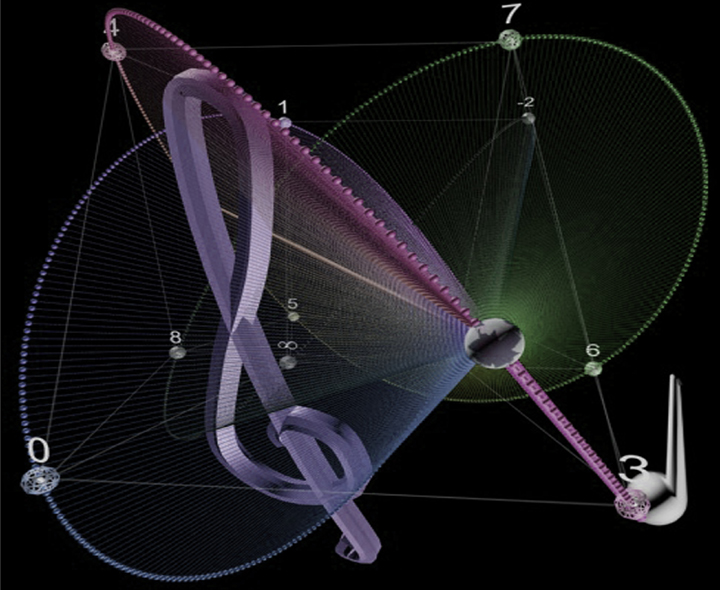
Two hyperspheres, sharing the same center.
One in red, green, blue. The other in cyan, magenta, yellow. Twelve symbols on each, interlocked in space, perfectly entangled.
Reach for the controls and spin them. The two hyperspheres turn together, the colored symbols sliding past each other, weaving through one another like two transparent worlds occupying the same place.
This is microtonal music made visible. Two orchestras, one tuned a quarter-tone away from the other, each with its own hypersphere. Together they cover all 24 notes between every octave — twice as many notes as a piano, twice as much harmony, twice as much possibility.
Press the demo button and listen to the Entangled Chorus, composed by Stéphane de Gérando. Watch the score scroll on the screen behind. The hyperspheres rotate to bring each chord to you as it sounds.
A universe with twice the colors.
In Western music, the octave is divided into 12 equal pitch classes — the chromatic scale. But other traditions and composers have explored finer divisions. Quarter-tone music doubles the resolution: 24 pitch classes per octave.
How do you visualize such a system? Gilles Baroin and Stéphane de Gérando chose an elegant solution: two Planet-4D hyperspheres, sharing the same center, perfectly entangled.
Hypersphere A carries the standard 12 pitch classes — an Orchestra A tuned to A = 440 Hz, modern concert pitch. Its symbols use the familiar Newton colors of Planet 4D: red, green, blue.
Hypersphere B carries the 12 quarter-tone pitch classes — an Orchestra B tuned a quarter-tone away. Its symbols use the complementary colors: cyan, magenta, yellow. Same four shapes (sphere, tetrahedron, cube, diamond) — only the colors shift.
The complementary color choice is mathematics made visible: complementary pitch classes carry complementary colors. The two hyperspheres are reflections across the chromatic divide.
The visitor can fly freely through this entangled space. Spatial sound, Shepard tones. Several display layers togglable: notes only, notes with chords, Hypersphere A alone, Hypersphere B alone, or both together.
Demo mode: the Entangled Chorus — a composition by Stéphane de Gérando for this model. The score appears on a screen behind the hyperspheres, scrolling as the music plays. The hyperspheres rotate to bring the current chord to your fixed user spot — same mechanism as Planet 4D.
This scene is the most recent member of the Planet 4D family — explicitly experimental. No MIDI song mode, no pilot navigation. The Entangled Hyperspheres invite contemplation more than navigation.
In this room: spin the hyperspheres first. Switch the display layers. Then press demo and let the Entangled Chorus carry you through the 24-tone universe.
Mathematical construction
Introduced by Baroin & de Gérando at MCM 2022 (Atlanta), LNCS 13267, pp. 86–98. Two Planet-4D hyperspheres placed concentrically. Each places 12 pitch classes as unit quaternions on S³.
- Hypersphere A: Orchestra A (440 Hz), RGB Newton colors
- Hypersphere B: Orchestra B (quarter-tone shifted), CMY complementary colors
Together they cover Z₂₄.
Complementary colors — mathematical justification
In Planet-4D, RGB encodes the three diminished seventh classes of Z₁₂. In Z₂₄, Orchestra B's diminished classes pair with the complementary colors:
- Cyan ↔ Red
- Magenta ↔ Green
- Yellow ↔ Blue
Shapes are preserved — the augmented triad C₃ structure exists in both orchestras.
Microtonal context
Ivan Wyschnegradsky (1893–1979) composed extensively for two pianos tuned a quarter-tone apart. Franck Jedrzejewski documented this tradition (Université de Paris 1, 2000). The Entangled Hyperspheres directly visualizes the Wyschnegradsky two-orchestra practice. Part of de Gérando's larger work Le Labyrinthe du Temps since 2020.
The Entangled Chorus
Composed by de Gérando for this model. The score scrolls on the screen as the music plays. The hyperspheres rotate to bring the current chord to the user spot — same mechanism as Scene 4.
Display layers and interaction
Notes, chords, Hypersphere A, Hypersphere B, both. Fly freely. Shepard tones. No MIDI, no pilot — experimental and contemplative.
The Planet 4D family
The 8th member of the family: Planet-4D, Hypersphere of Chords, AnySet, Chicken wire, Hypersphere of other Tonnetze (with Bigo), of Temperaments (with Calvet), of Spectra (with de Gérando), Entangled Hyperspheres (with de Gérando, 2022) — this scene.
Further reading
- Baroin, G. & de Gérando, S. (2022). When Virtual Reality Helps Fathom Mathemusical Hyperdimensional Models. MCM 2022, LNCS 13267, pp. 86–98. Springer.
- Baroin, G. & de Gérando, S. (2022). The Entangled Hyperspheres, an innovative approach to visualize microtonal music. Les Cahiers de l'Institut International pour l'Innovation, la Création Artistique et la Recherche, icarEditions.
- Jedrzejewski, F. (2000). Ivan Wyschnegradsky et la musique microtonale. Université de Paris 1.
- Baroin, G. (2011). The Planet-4D Model. MCM 2011, LNCS 6726. Springer.
Credits
- Stéphane de Gérando (Conservatoire Ville de Paris) — co-creator of the model, composer of the Entangled Chorus