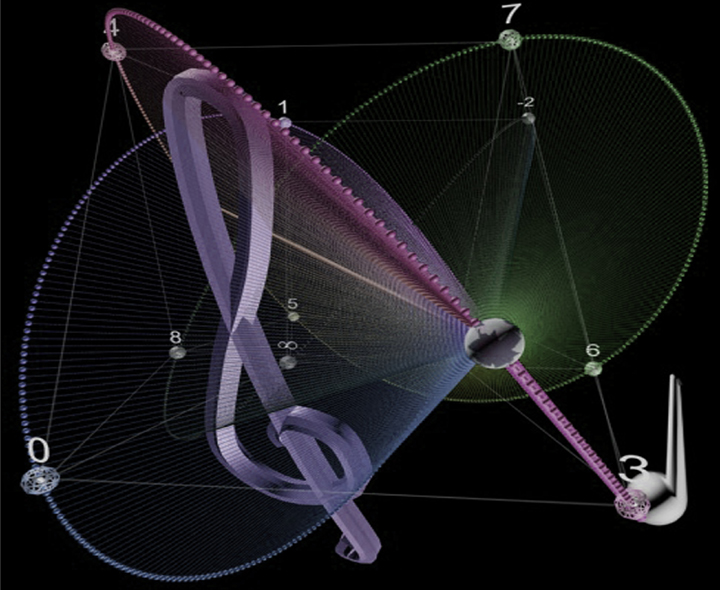
Look up. The sky is a mosaic — pi visualized as a field of colors, the work of John Sims, master of pi.
On the wall, a small portrait of John watches you.
A blue stone appears — the first note. A number is written on it. Then more spheres begin to fall from the sky. Each one is a digit of pi. Each one is a colored note. The pi song.
They fall past you. They fall through the floor. They fall into the infinite below, because pi has no end and the song has no end.
You can stand still and listen. You can walk through the rain of digits. You can fly up to meet them as they appear, or fly down to follow them into the void. The song will never repeat itself in any human lifetime.
This is John's Pi World — a tribute to John Sims (1968–2022). He spent his life sharing pi with the world. Welcome to his world.
John Sims was a mathemusician, conceptual artist, and civil rights activist. He lived in Sarasota, Florida, where he was the math coordinator at Ringling College of Art and Design. He died on December 11, 2022, at the age of 54.
His work crossed disciplines without apology — visual art, sculpture, music, video, performance, poetry, activism. Mathematics ran through all of it. And one mathematical object above all others held his lifelong attention: pi.
John saw pi as something more than a number. He saw it as a symbol of irrationality, of endless variation, of mathematical truth that refuses to be tamed. He visualized pi as colors, as quilts, as music, as flags. His SquareRoots: A Quilted Manifesto (2008) — 13 quilts made with Amish quilters in Sarasota, each visualizing pi in a different base — became one of the iconic works of mathematical art of the 21st century.
He also composed the pi song — a musical interpretation of pi where each digit becomes a note. The score belongs to no single performer. John invited many musicians to interpret it in their own way. Pi is collaborative.
This scene is a virtual version of John's pi song, generated in real time. Five different musical interpretations are available, based on five different number bases — Base 7, Base 12, Base 10, Base 5 Major, Base 5 Minor. Each produces a different musical reading of the same irrational truth.
The first sphere is a blue stone with the base number written on it. Then the digits fall, one by one, each a sphere in its Newton color, each a Shepard tone played as it appears. The visitor controls the rain intensity — slow and contemplative, or fast and dense.
Walk freely on the ground. Fly upward. Fly downward into the void. Four teleport waypoints — down, middle, top, sky — offer shortcuts.
The skybox displays one of John's pi artworks — mathematics rendered as color, as image, as memorial.
The spheres fall forever. The song never ends.
And there is more pi in this museum. In the Geode (Scene 6), you can watch a film of another pi piece — a different interpretation, composed by Moreno Andreatta. Two artists, two pi songs, converging in the same mathemusical spirit.
In this room: stand still and listen first. Switch bases and hear how the same number tells a different story in each one. Then walk, fly, or teleport. Stay as long as you need.
John Sims (1968–2022)
Born in Detroit, 1968. Math coordinator at Ringling College of Art and Design. Artist in residence at the Ringling Museum, 2020. Died at home in Sarasota, December 11, 2022.
Major bodies of work:
- SquareRoots: A Quilted Manifesto (2008) — 13 quilts with Sarasota Amish quilters
- Recoloration Proclamation — Confederate flag recolorings
- Pi Day Anthem — with Vi Hart and Kenny Drew Jr.
- 31415: The π Collection (2015) — CD
- From the Chambers (2022) — his final sculpture
- Ringling Museum retrospective: From the Chambers: Honoring John Sims (2025)
The pi song
John composed the pi song as a musical interpretation of pi. He never claimed exclusive authorship of the performance — he invited many musicians to interpret the score. Pi was a collaborative project for John.
Pi in different bases
In base 10: 3, 1, 4, 1, 5, 9, 2, 6, 5, 3… In base 12, 7, or 5: completely different digit sequences. Each mapped to a different scale produces a different musical reading.
Five base interpretations, each precomputed to 1000+ digits:
- Base 7 / Diatonic — C D E F G A B
- Base 12 / Chromatic — all 12 pitch classes
- Base 10 / MinoMajor — C D E♭ E F G A♭ A B♭ B
- Base 5 / Penta Major — C D E F♯ G♯
- Base 5 / Penta Minor — C D E♭ F♯ G
Each digit = Newton-colored sphere, falling from a random horizontal position at configurable height. Shepard tone on appearance. Rain intensity slider (0–100%) controls spawn rate.
The generative nature
The piece will not repeat in any human lifetime. This is true to John's philosophy: pi is irrational — never terminates, never repeats, never settles. The musical piece honors that mathematical truth.
Pi in the museum
Beyond this room, pi appears elsewhere in the museum. The Geode (Scene 6) holds a film of another pi composition by Moreno Andreatta — an independent musical interpretation of pi. Two artists exploring the same mathematical object through different sonic lenses.
Further reading
- Sims (2015). 31415: The π Collection.
- Sims (2008). SquareRoots: A Quilted Manifesto.
- Ornes (2019). Math Art: Truth, Beauty, and Equations — includes Sims's essay "The Art of Pi."
Credits
- John Sims (1968–2022) — the pi song, the visual artworks, the lifelong devotion to pi
- The Ringling College of Art and Design — John's institutional home in Sarasota
- The Amish quilters of Sarasota — collaborators on SquareRoots
- Moreno Andreatta — a separate pi composition shown in the Geode