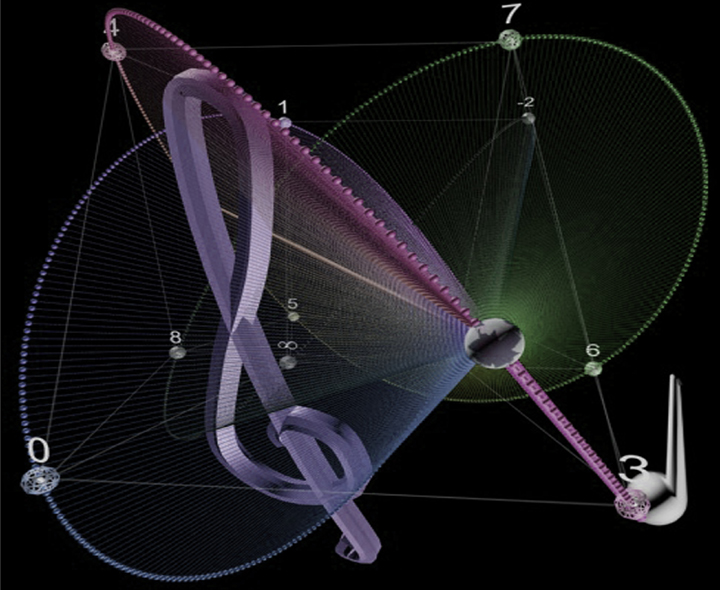
A single voice. Then two. Then three. Then four.
Each voice is a colored sphere on a chromatic clock — Newton's Circle, the same circle you walked at the beginning of the museum. You control each voice with its own up and down buttons. Press up and the voice steps one semitone higher. Press down and it steps one semitone lower. One step at a time. Voice leading by hand.
When two voices play, a line connects them. When three play, a triangle. When four play, a graph with six lines connecting all four notes.
Press F1 to open the menu. Switch to TIPI and the circles multiply — one disc, two parallel circles forming a cylinder, three circles on cube faces, four circles wrapping a tetrahedron. Switch to BombyXz and the harmony explodes into a spherical cloud of triplets. Switch to the 3-voice harmonic space and walk through every chord you could ever build from three notes — with the Cube Dance lighting up inside it like a constellation.
This is Planet Voices — the most flexible room in the museum. A playground for parsimonious voice leading.
Parsimonious voice leading is one of the most beautiful ideas in music theory. The principle is simple: when one chord changes to another, the voices should move as little as possible. One semitone here, one semitone there. Three notes stay, one moves. Two move, two stay. The smoothest possible transformation.
Planet Voices is a workshop for exploring this principle. The visitor controls up to four voices, each with its own up and down buttons. Step them one semitone at a time. Watch how the harmonic shape evolves with each tiny move.
The scene starts with Newton+ — the Newton's Circle from Scene 1, extended to support multiple voices on a single chromatic clock. Each active voice is a Newton-colored sphere on the circle.
- 1 voice — a single point
- 2 voices — a line connecting them
- 3 voices — a triangle
- 4 voices — a complete graph with four points and six lines connecting all of them
Each voice can be piloted independently, or all voices can be transposed together.
Press F1 to open the menu. The same voice-leading principle can be visualized through several other models:
TIPI — developed with Emmanuel Amiot. Newton's Circle multiplied into space.
- 1 voice — a single Newton's Circle
- 2 voices — a cylinder formed by two parallel circles. A line connects the two playing notes
- 3 voices — three circles arranged on three faces of a cube. A triangle floats in space connecting the playing notes
- 4 voices — a tetrahedron with a Newton's Circle on each of its four faces. Six lines connect all four playing notes — the same complete graph from Newton+, now drawn through space
The circles rotate on their own axes for a dramatic visual effect.
Geometric models — organized by dimension, fixed voice count:
- 1D — the Line. A Newton's Circle laid out as a line. 1 voice.
- 2D — the Square, the Triangle, the Cylinder, and the Möbius strip. 2 voices. The Möbius reappears here from Scene 8 — this time as a two-voice space.
- 3D — 3 voices, the natural dimension for triadic harmony:
– The Big Cube — all 12×12×12 ordered triples as points in a grid – The 3-voice harmonic space — Dmitri Tymoczko's three-voice orbifold, the complete space of every possible chord that can be built from three notes, including chords with repeated notes such as a single note tripled. Inside this larger space, the Cube Dance is highlighted at full size. The 24 major and minor triads and the 4 augmented triads of the Cube Dance shine against the smaller field of all other chords around them. This entire scene was designed in collaboration with Richard Cohn. – BombyXz — an original creation by Gilles Baroin. A spherical shell distribution where each chord is a point on a 3D shell
The 3-voice harmonic space is the richest geometric model in this room. The visitor can wander through every chord buildable from three notes, and watch the Cube Dance appear inside it — a constellation of the most parsimonious triads, joined by the smoothest voice-leading paths.
The quark system applies here at three levels: 1 voice = a monoquark, 2 voices = a meson, 3 voices = a baryon. Four-voice tetraquark systems are the territory of Scene 7 (the Octatonic Tesseract) and Scene 9 (Orbifolds), where serious 4-voice analysis takes place. Here in Scene 14, four voices is the upper limit of the TIPI model and Newton+ — playful and direct rather than analytical.
All sounds are Shepard tones, consistent with the rest of the museum.
In this room: start with Newton+. Step the voices one at a time. Add a second voice and watch the line. Then a third for the triangle. Then a fourth for the complete graph. Switch to TIPI and feel the rotation. Switch to the 3-voice harmonic space and find the Cube Dance inside.
Parsimonious voice leading
Parsimonious voice leading is the principle that, when one chord transforms into another, the voices should move by the smallest possible interval — usually one or two semitones — and the maximum number of voices should remain unchanged. This principle is at the heart of neo-Riemannian theory (Cohn, 1996; Hyer, 1995) and Tymoczko's geometric voice-leading theory (2006, 2011).
The principle has both an acoustic and a geometric character. Acoustically, parsimonious transformations sound smooth — the listener perceives continuity rather than rupture. Geometrically, they trace paths in chord space where the distance between consecutive chords is minimal.
Scene 14 is the most flexible room in the museum for exploring this principle. It offers several geometric models, each revealing a different aspect of the same idea.
The Newton+ model
Newton+ extends Newton's Circle (Scene 1) to support multiple simultaneous voices. The visitor controls 1 to 4 voices, each presented as a Newton-colored sphere on the chromatic clock. Connecting lines form polygons:
- 2 voices: a line (dyad)
- 3 voices: a triangle (triad)
- 4 voices: a complete K4 graph — 4 vertices, 6 edges connecting every pair of voices
Each voice has independent up and down controls. A global transposition operator transposes all voices together.
The TIPI model
Developed with Emmanuel Amiot. TIPI multiplies Newton's Circle into space:
- 1 voice: a single Newton's Circle (equivalent to Scene 1)
- 2 voices: two parallel Newton's Circles forming a cylinder
- 3 voices: three Newton's Circles arranged on three orthogonal faces of a cube
- 4 voices: four Newton's Circles arranged on the four faces of a tetrahedron — six lines through 3D space
Each disc rotates on its own axis, controlled by TRot+, TRot−, and TRot0 buttons.
Geometric models by dimension
1D models (1 voice): Line — a Newton's Circle laid out linearly
2D models (2 voices): Square, Triangle, Cylinder, Möbius (the natural topology of unordered pitch pairs — also seen in Scene 8)
3D models (3 voices):
- The Big Cube — all 12³ = 1728 ordered triples as points in a grid
- The 3-voice harmonic space — Tymoczko's three-voice orbifold, designed in collaboration with Cohn, with the Cube Dance highlighted inside
- BombyXz — an original 3D arrangement by Gilles Baroin
The 3-voice harmonic space — Tymoczko's orbifold
This is the central 3D model of Scene 14. It is the complete space of all 3-voice chords buildable from the 12 chromatic pitch classes — including chords with repeated pitch classes such as a single note tripled or a doubled note plus a third. The total number of unordered three-note multisets from a 12-note alphabet is 364; the museum implementation contains 348 chord positions visible.
The space is Dmitri Tymoczko's three-voice orbifold T³/S³, introduced in The Geometry of Musical Chords (Science, 2006) and developed extensively in A Geometry of Music (Oxford, 2011, Chapter 3). It has a triangular prism structure: 13 triangular cross-sections stacked along a vertical axis, with the top and bottom layers identified — the space wraps around. The three corners of each triangular layer are orbifold singularities where the most symmetric chords (tripled unisons and augmented triads) collapse to a single point.
Inside this larger space, the Cube Dance appears as a highlighted subgraph. The 28 chords of the Cube Dance — the 24 major and minor triads plus the 4 augmented triads — render at full size. All other chords render at one-eighth size: visible but small. The Cube Dance shines through the orbifold like a constellation against a sky of fainter stars.
The MmvM implementation of this scene was designed entirely in collaboration with Richard Cohn. The mathematical orbifold itself is Tymoczko's. But everything that makes this scene work in virtual reality — the choice of 348 chord positions and their precise z-level layout, the level filter system, the Cube Dance highlighting that makes the parsimonious subgraph visually appear inside the larger space, the visual design choices throughout — was developed jointly by Baroin and Cohn during the Yale stay in 2023 and refined for MCM 2024 in Coimbra (Portugal).
The Cube Dance is itself the work of Jack Douthett and Peter Steinbach (Parsimonious Graphs, Journal of Music Theory, 1998), named by Douthett (1992), and analyzed in depth by Cohn (Audacious Euphony, Oxford, 2012, Chapters 22–24). The 3D embedding of the Cube Dance as a vertical necklace of four hexatonic cubes appears in Cohn's forthcoming book Mathemusical Models of Pitch and Time (Oxford, ~2027), with figures by Gilles Baroin.
The autopilot in Scene 14 navigates only the 24 nearly-even triads of the Cube Dance. The 4 augmented triads are visible but not autopilot-navigable. The remaining ~320 chords of the Tymoczko orbifold are outside the navigation system.
BombyXz — original 3D arrangement
An original creation by Gilles Baroin. A spherical shell distribution where each chord is placed on a 3D shell according to its three voice coordinates. Maximum visual density — harmony as a star field.
The quark system
The quark system used throughout the museum applies here at three levels:
- 1 voice = monoquark (single Newton-colored sphere)
- 2 voices = meson (two-quark system)
- 3 voices = baryon (three-quark system)
Tetraquarks (4 quarks) are not used in this scene. The four-voice models (Newton+ with 4 voices, TIPI with 4 voices) display four independent monoquarks rather than tetraquark groupings. The tetraquark representation is reserved for Scene 7 and Scene 9.
Sound
All notes are rendered as Shepard tones, consistent with the museum's general approach. Each active voice plays its own continuous Shepard tone, looping while the voice is held.
Further reading
- Tymoczko, D. (2006). The Geometry of Musical Chords. Science, 313(5783), 72–74.
- Tymoczko, D. (2011). A Geometry of Music. Oxford University Press. Chapter 3.
- Douthett, J., & Steinbach, P. (1998). Parsimonious Graphs. Journal of Music Theory, 42(2), 241–263.
- Cohn, R. (1996). Maximally Smooth Cycles. Music Analysis, 15(1), 9–40.
- Cohn, R. (2012). Audacious Euphony. Oxford University Press. Chapters 22–24.
- Cohn, R. (forthcoming, ~2027). Mathemusical Models of Pitch and Time. Oxford University Press. Figures by Gilles Baroin.
Credits
- Dmitri Tymoczko (Princeton University) — the three-voice orbifold T³/S³ (A Geometry of Music, 2011)
- Richard Cohn (Yale University) — co-designer of the 3-voice harmonic space scene in MmvM. The mathematical orbifold is Tymoczko's, but the implementation in MmvM — the level filter, the Cube Dance highlighting inside the orbifold, the visual design choices — was developed entirely in collaboration with Cohn during the Yale 2023 stay and refined for MCM 2024 in Coimbra. Hexatonic-cube reading: Audacious Euphony (Oxford, 2012, Chapters 22–24).
- Jack Douthett (1942–2021) and Peter Steinbach — the Cube Dance graph (1992; published 1998)
- Emmanuel Amiot (Université de Perpignan, LAMPS) — TIPI model co-development
Note for general acknowledgements
Thomas Noll (Escola Superior de Música de Catalunya) — tester and advisor across the museum, in particular for Scene 3 (Torus of Thirds) and Scene 14 (Planet Voices). A dedicated room with Thomas Fiore is planned for a future version of the museum.