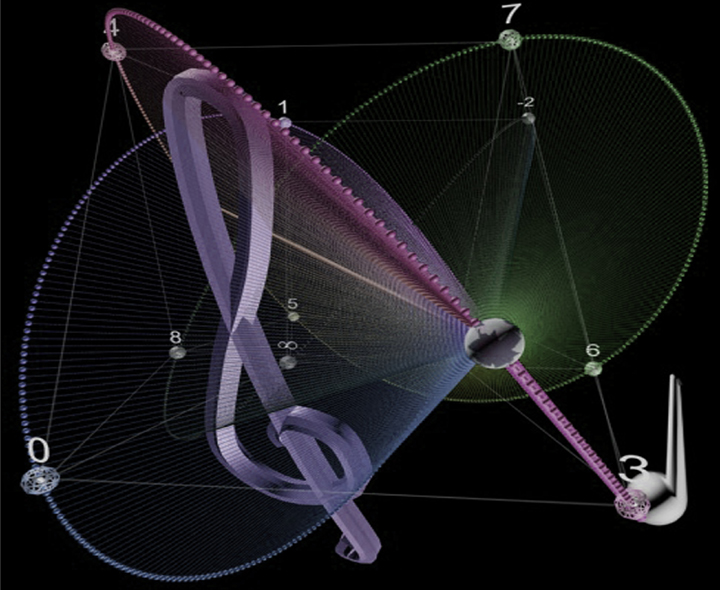
Hundreds of tiny four-colored clusters fill the space around you. Each one is a four-voice chord — every chord you could possibly build from four notes, all 1365 of them, gathered together in a single living catalogue.
The clusters are arranged according to a deep geometric idea: chords that sound close together sit close together. Move through the space and you are moving through harmony itself.
Two views, one structure. The cube view shows the catalogue — every chord in its place. Press a button and the structure folds into a ring, where transposition becomes a literal circle. Watch the chords flow from one arrangement to the other. The same harmony, seen two different ways.
This is the geometry of music itself — every four-note chord, given its place in space.
This room is experimental and still in development — the four-voice orbifold is the most complex space in the museum, and it will keep growing.
In the early 2000s, Dmitri Tymoczko (Princeton University) discovered something remarkable: the space of all chords has a precise mathematical shape — an orbifold — and the smoothest voice leadings between chords are literally the shortest paths through that shape. His 2006 paper in Science, and his 2011 book A Geometry of Music, are now foundational works of mathematical music theory. The orbifold framework is one of the most important developments in the field over the past two decades.
This room is the four-voice version of Tymoczko’s construction, written mathematically as T⁴/S⁴. Every four-note chord — every combination of four pitch classes from the chromatic scale — has its place in this geometry. 1365 chords in total, including chords with doubled or tripled notes. Each chord is shown as a tetraquark — the same four-Newton-colored-sphere representation used in Scene 7. An alternate display shows each chord as a colored tetrahedron, closer to Tymoczko’s original published figures.
The room offers two layouts, chosen by the visitor:
The cube layout treats the four-voice structure symmetrically — each of the four voices is one of the four dimensions. The visitor rotates a four-dimensional projection in real time to read the structure from different angles.
The ring layout pulls out the transposition direction as a literal circle. Chords that are the same shape in different keys arrange themselves around the ring. The other three dimensions — the shape dimensions — live inside it. This view makes a deep mathematical fact visible: transposition is fundamentally different from the other ways a chord can change.
Filters by scale, chord type, and voice redundancy let the visitor isolate musically meaningful subsets — the diatonic chords, the pentatonic chords, the dominant sevenths, the diminished family.
Where Scene 9 fits. Scene 14 (Planet Voices) presents Tymoczko’s three-voice orbifold T³/S³ as part of a wider playground. Scene 9 is dedicated entirely to the four-voice case — the richer, harder, and more ambitious of the two.
A note on this room. Because four-voice space is genuinely difficult to visualize, Scene 9 is the most experimental room in the museum. It is under active development, and what you see is an early iteration — powerful, but not yet finished. Expect it to grow and change.
In this room: start in the cube view to see the catalogue. Toggle to the ring view to feel transposition as a circle. Filter by a familiar scale and listen.
Note: Scene 9 is the most complex and most experimental room in the museum. The four-voice orbifold is mathematically and visually demanding, and the scene is under active development. This chapter describes an early, evolving iteration — features and visual choices will continue to change.
The orbifold T⁴/S⁴
Tymoczko’s construction takes the space of ordered four-voice chords — the 4-torus T⁴, one circular dimension per voice — and identifies chords that differ only in voice ordering. The resulting quotient T⁴/S⁴ is an orbifold: a geometric space that is mostly smooth but has boundary structures (the mirror walls) where two voices coincide. The orbifold’s geometry encodes voice leading directly — the smoothest motion from one chord to another is the shortest path through the space.
The notation Tⁿ/Sⁿ is Tymoczko’s own convention from his 2006 Science paper: the n-torus Tⁿ modulo the symmetric group Sⁿ (on n letters). The superscript on Sⁿ tracks the dimension n consistently across both factors of the quotient.
1365 chords
The 1365 positions are the four-element multisets drawn from the 12-element pitch-class set Z₁₂. The count is C(12+4−1, 4) = 1365. This includes every multiset: chords with all four voices distinct, chords with doubled or tripled notes, and the trivial unisons where all four voices share a single pitch class.
Two layouts, two truths
The cube layout projects T⁴/S⁴ into three dimensions using the original four-voice coordinates, with user-controlled rotation in the fourth dimension. All four axes are treated symmetrically — useful for navigation, for filtering, for seeing the full catalogue at once.
The ring layout reparameterizes the space along an orthonormal basis aligned with the privileged transposition direction (1,1,1,1)/2. Transposition becomes an angular coordinate around a ring; the three orthogonal directions encode the chord’s shape (its internal interval structure, independent of key). This layout reveals what the cube hides: one of the four dimensions of T⁴/S⁴ is fundamentally different from the others, by virtue of being circular.
Parsimonious voice leading
Motion through the orbifold corresponds to voice leading. Short paths = smooth voice leading. The orbifold makes Tymoczko’s central claim — that voice leading is a geometric phenomenon — directly inspectable in the visualization.
Filters and navigation
Filters by scale (chromatic, diatonic, pentatonic, octatonic), by chord type (triads, sevenths, augmented, diminished), and by voice redundancy let the visitor restrict the visible set to musically coherent subsets. Selection of any chord highlights its closest neighbors, and an autopilot offers guided tours through specific subsets.
Status
Scene 9 is the most experimental room in the museum and one of its most active works in progress. The current cube and ring layouts are stable; a third layout — a fiber-bundle view that exposes additional structure of T⁴/S⁴ — is in development. This chapter will grow as the scene matures.
Further reading
- Tymoczko, D. (2006). The Geometry of Musical Chords. Science, 313(5783), 72–74.
- Tymoczko, D. (2011). A Geometry of Music. Oxford University Press. Especially Chapter 3.
- Callender, C., Quinn, I., & Tymoczko, D. (2008). Generalized Voice-Leading Spaces. Science, 320(5874), 346–348.
- See also Scene 14 (Planet Voices) for the three-voice orbifold T³/S³.
Credits
Dmitri Tymoczko (Princeton University) — the orbifold framework, the foundational publications, and the design vocabulary that this scene visualizes.
Gilles Baroin — Unity implementation, including the cube and ring layout system and the integration of the tetraquark representation from Scene 7.