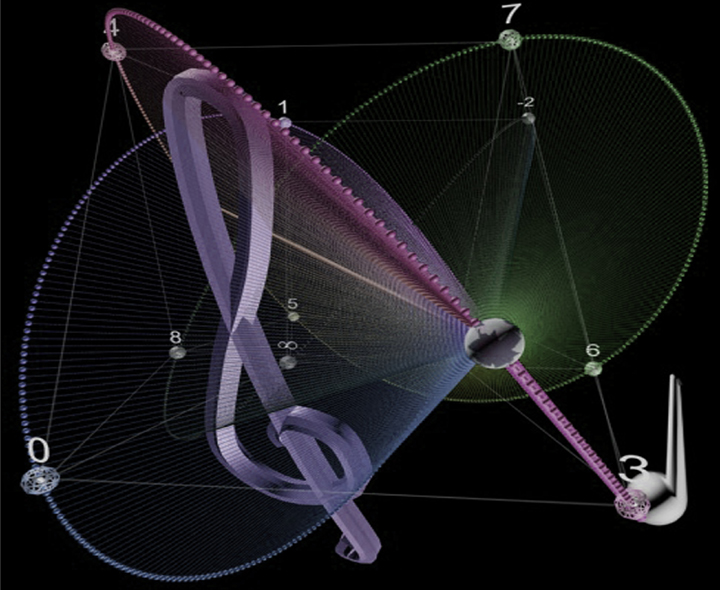
Creator and developer
Gilles Baroin — Université de Toulouse — www.MatheMusic.net
Scene contributors
- Jack Douthett (1942–2021) and Peter Steinbach — originators of the Cube Dance (Scene 5) and of the octatonic tesseract / 4-Cube Trio (Scene 7), both from “Parsimonious Graphs” (Journal of Music Theory, 1998). Memorial for Jack in the Museum Hall.
- Richard Cohn (Yale University) — study and presentation of the octatonic tesseract (Scene 7); the 3-voice harmonic space (Scene 14); films in Scene 6
- Gilles Baroin — the tetraquark visualization in Scenes 7 and 9 (each four-note chord as four Newton-colored spheres), and the Unity implementation throughout
- Dmitri Tymoczko (Princeton University) — Scene 9 (Orbifolds), Scene 14 (T³/S³ orbifold), geometric study of seventh-chord voice-leading (Scene 7)
- Julian Hook (Indiana University Bloomington) — Scene 2 (hexagonal Tonnetz, from Science 2006); study and imaging of seventh-chord spaces (Scene 7); Chicken Wire mode inspiration (Scenes 3 and 4)
- David Lewin (1933–2003) — Scene 15 (Lewin's Compass): the Generalized Interval System (GIS) framework from Generalized Musical Intervals and Transformations (Yale, 1987; Oxford, 2007)
- Dave Clampitt (Ohio State University) — Scene 15 (Lewin's Compass): well-formed scale theory (with Norman Carey, 1989) and the Christoffel word framework (with Thomas Noll)
- Norman Carey — Scene 15 (Lewin's Compass): co-author of “Aspects of Well-Formed Scales” (1989), the foundational paper on well-formed scales
- Thomas Noll (Escola Superior de Música de Catalunya) — Scene 15 (Lewin's Compass): Christoffel word framework, height-width duality (with Dave Clampitt); also general tester and advisor across the museum (Scene 3, Scene 14)
- Emmanuel Amiot (Université de Perpignan, LAMPS) — Scene 4 (M5/M7 symmetries), Scene 8 (Möbius Strip), Scene 10 (Fourier Phases), Scene 14 (TIPI)
- Jason Yust (Boston University) — Scene 10 (Fourier Phases 4D)
- Ian Quinn (Yale University) — Scene 10 (Fourier Phases 4D): DFT / Fourier balance theory, foundational reference. Also tested the MmvM in person at Yale.
- Clifton Callender (Florida State University) — Scenes 9 and 14: Generalized Voice-Leading Spaces / OPTIC framework (with Quinn and Tymoczko, Science 2008)
- Franck Jedrzejewski (Université de Paris) — Scenes 3 and 4 (JQZ display mode): “Non-Contextual JQZ Transformations” (MCM 2019)
- Louis Bigo (CRIStAL / Université de Lille) — Scenes 3 and 4 (Generalized Tonnetze display mode); joint Hypersphere of Tonnetze (Geode film)
- Maria Mannone (CNR–ICAR, Italy; University of Potsdam; Ca' Foscari Venice) — Scene 11 (CubeHarmonic)
- Stéphane de Gérando (CRR Amiens Métropole; Director icarEnsemble / icarEditions) — Scene 12 (Entangled Hyperspheres), Geode films
- Moreno Andreatta (CNRS / IRMA, Université de Strasbourg; associate researcher IRCAM) — Scene 5 (The Gunner's Hamiltonian Dream), Geode film (pi composition), video work on the Cube Dance display mode in Scenes 3 and 4
- John Sims (1968–2022) — Scene 13 (the pi song, pi artwork). Memorial in Scene 13.
- Guerino Mazzola (University of Minnesota; SMCM founding President) — Scene 3 (Torus of Thirds)
- Charles Giulioli — Newton 12-color system (with Baroin)
- Hugues Seress — Geode films (Polarized Tonnetz, SpinnenTonnetz)
- Ildar Kakhanov (Peabody Institute, Johns Hopkins University) — Geode film (Shadow Tonnetz)
- André Calvet — Geode film (Hypersphere of Temperaments)
- Carlos Agon (IRCAM / Sorbonne Université, Paris) — referenced in Scene 2 bibliography (co-author with Romero-García and Bloch, MCM 2022)
- E. Kitamura, J. Huang, R. Sugawara, Y. Kitamura (Tohoku University) — physical CubeHarmonic technology
- Gonzalo Romero-García (EPITA, Paris) — MIDI files with chord recognition (Scenes 2, 3, 4)
- Giovanni Albini — Hamiltonian paths on the Hypersphere of Chords (Chords display mode, Scenes 3 and 4)
- Pyrene Baroin / Piran Design (age 10) — Scene 3 color palette, Museum Hall architecture (mushroom portals, transparent lift, glass floors, diagonal staircases, height slider design, secret passage, the children's-eye design philosophy throughout)
Future room — in preparation
- Elaine Chew (King's College London) — Spiral Array room (door exists in the museum, room currently under construction). Founding SMCM Secretary; founding editorial board Journal of Mathematics and Music.
Testers and advisors
- Thomas Noll (Escola Superior de Música de Catalunya) — see Scene contributors above
- Ian Quinn (Yale University) — see Scene contributors above
- Roberto Figueroa (University of the Philippines; formerly International Christian University, Tokyo) — VR pedagogy advisor and museum tester
- Mariana Montiel (Georgia State University) — made possible the world premiere at the Museum of Design Atlanta (MoDA), June 2022; mathematical music theory community; pedagogy
Communities
The Society for Mathematics and Computation in Music (SMCM) — the international research community within which MmvM has grown.
In memoriam
- Jack Douthett (1942–2021)
- John Sims (1968–2022)
- David Lewin (1933–2003)
Featured composers and artists
- Isaac Newton — Newton color theory (1704)
- Leonhard Euler — original Tonnetz (1739)
- Richard Wagner — Tristan und Isolde (1859/1865) — Scene 7 animation
- Roger Waters / Pink Floyd — The Gunner's Dream (The Final Cut, 1983) — Scene 5
- Ray Charles — Georgia on My Mind — Scene 10 demo
Note
Each scene's chapter contains its own complete credit list with affiliations and references. This page is a summary.