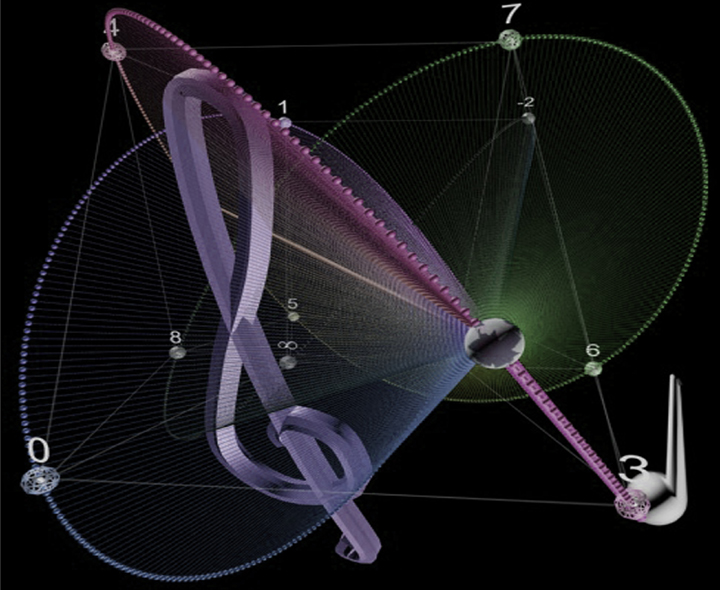
A giant clock in front of you. Twelve colored points around its rim — the same Newton’s Circle you have already met on the ground floor, now at eye level.
This is Lewin’s Compass. The room where intervals become objects you can hold. Two experiments share the clock.
GIS — the Generalized Interval System. Touch one of the points and it lights up. Touch another and an arrow flies between them, labeled with the distance — the interval. Touch a third and the arrows multiply, with one of them, in a new color, showing what happens when the first two are joined. The intervals add. The music plays the path.
Well-formed scales. You set one point as the start and the next as a generator, and watch a scale unfold around the circle, one identical step at a time. Stack a fifth seven times and the diatonic scale appears. Stack it five times and the pentatonic. A word at the center of the circle spells out the scale’s step pattern — and glows when the scale is one of the well-formed ones humanity has sung for thousands of years.
This room is experimental and still in development — an early exploration that will keep growing.
This room is dedicated to two ideas in music theory: the Generalized Interval System (GIS) and well-formed scales. Both live on the same Newton’s Circle from the ground floor, now hanging in front of you as a giant clock.
The GIS framework was introduced by David Lewin (1933-2003) in his 1987 book Generalized Musical Intervals and Transformations. For Lewin, an interval was not a static distance between two notes — it was a directed motion, an arrow, a transformation that could be composed with others.
In GIS mode, you click three points: A, B, C. Small labels above each point mark its role: (a), (b), (c). The arrows A to B and B to C are white; the composition arrow A to C is orange — showing that interval(A to C) = interval(A to B) + interval(B to C). When all three are placed, a readout names the resulting chord.
In well-formed scales mode, you click a Root and a Generator (the step size). The scale unfolds, and you grow or shrink it with + / – buttons. Stack a fifth seven times for the diatonic scale. A Christoffel word at the center spells out the step pattern — and when that word uses at most two distinct letters, the scale is well-formed: the word glows yellow. This framework was developed by Dave Clampitt and Thomas Noll.
Both modes share controls: Play (replay), Reset, Reverse (button reads “Flip” normally and “pilF” when active), Symmetry, and Transpose. A Tempo slider and Follower size slider are also available. A Content switch toggles between Pitch (12 chromatic pitch classes) and Rhythm (8 beat-slots). An Orientation switch turns the circle from vertical to horizontal.
A note on this room. Lewin’s Compass is one of the museum’s newest and most experimental rooms — an early version that will grow and change.
In this room: pick GIS, click three points, and watch the composition arrow appear. Then switch to Well-Formed, click a Root, click a fifth as your Generator, and press + until the Christoffel word glows.
Note: Lewin’s Compass is one of the newest and most experimental rooms in the museum. This chapter describes an early, evolving iteration.
David Lewin and the GIS
David Lewin’s Generalized Musical Intervals and Transformations (Yale, 1987; Oxford, 2007) founded the field of transformational music theory. Lewin defined a Generalized Interval System (GIS) as a triple (S, IVLS, int) where S is a space of musical objects, IVLS is a group of intervals acting on S, and int(s, t) returns the interval taking s to t. The group structure means intervals compose: int(A, C) = int(A, B) composed with int(B, C). Intervals are not distances — they are transformations.
Well-formed scale theory — Dave Clampitt and Thomas Noll
A well-formed scale is a scale generated by repeated application of a single interval, with at most two distinct step sizes. Introduced by Norman Carey and Dave Clampitt (Music Theory Spectrum 11, 1989) and developed by Dave Clampitt and Thomas Noll through the Christoffel word framework (their 2011 Music Theory Online paper received the SMT Outstanding Publication Award in 2013).
Classical results emerge naturally:
- Diatonic = 7 stacks of a fifth
- Pentatonic = 5 stacks of a fifth
- Whole-tone = 6 stacks of a whole tone — all one step size
- Diminished 7th = 4 stacks of a minor third
Arrow color coding
Arrows are color-coded: direct arrows A to B and B to C are white; the composition arrow A to C is orange; in Well-Formed mode the generator arrows are green.
Further reading
- Lewin, D. (1987 / 2007). Generalized Musical Intervals and Transformations. Yale / Oxford.
- Carey, N. and Clampitt, D. (1989). Aspects of Well-Formed Scales. Music Theory Spectrum, 11(2).
- Clampitt, D. and Noll, T. (2011). Modes, the Height-Width Duality, and Handschin’s Tone Character. Music Theory Online, 17(1).
- Hook, J. (2023). Exploring Musical Spaces. Oxford University Press.
Credits
- David Lewin (1933-2003) — author of Generalized Musical Intervals and Transformations (Yale, 1987; Oxford, 2007).
- Norman Carey and Dave Clampitt (Ohio State University) — original well-formed scale theory (1989).
- Dave Clampitt (Ohio State University) and Thomas Noll (Escola Superior de Musica de Catalunya) — Christoffel word framework, height-width duality.
Scene 15 status: experimental, first iteration, under active development. Future evolutions planned.