PART 1 — GILLES BAROIN: THESIS & PUBLICATIONS
PhD Thesis
Baroin, G. (2011). Applications de la théorie des graphes à des objets musicaux : modélisations, visualisations en hyperespace. PhD thesis, Université Toulouse le Mirail — Toulouse II. Directeurs: Louis Ferré & Jean-Michel Court. Available: https://theses.hal.science/tel-00943407v1
Journal Articles
Amiot, E., & Baroin, G. (2015). Looking at old and new isometries between pc-sets in the Planet-4D Model. Music Theory Online, 21(3). Available: https://hal.science/hal-01215253v1
Baroin, G., & de Gérando, S. (2012). Sons et représentation visuelle en hyperespace : l'hypersphère des spectres. Les Cahiers de l'Institut International pour l'Innovation, la Création Artistique et la Recherche. Available: https://enac.hal.science/hal-02942200v1
Book Chapters
Andreatta, M., & Baroin, G. (2016). An Introduction on Formal and Computational Models in Popular Music Analysis and Generation. In Aesthetics and Neuroscience. Springer. ISBN 978-3-319-46232-5. DOI: 10.1007/978-3-319-46233-2_16
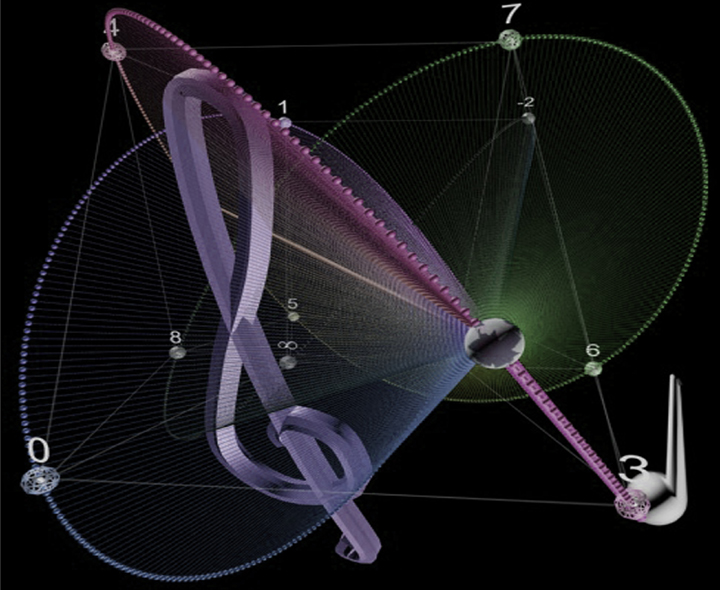
Baroin, G. (2011). The Planet-4D Model: An Original Hypersymmetric Music Space Based on Graph Theory. In Mathematics and Computation in Music. MCM 2011. LNCS Vol. 6726, pp. 326–329. Springer. DOI: 10.1007/978-3-642-21590-2_25
Conference Papers
Andreatta, M., Baroin, G., & Seress, H. (2015). The Spinnen-Tonnetz. MCM 2015, London. pp. 315–320.
Baroin, G., & Calvet, A. (2019). Visualizing Temperaments: Squaring the Circle? MCM 2019, Madrid. pp. 333–337.
Baroin, G., & Calvet, A. (2020). Outils d'informatique musicale appliqués en tempéramentologie. JIM 2020, Strasbourg.
Baroin, G., & de Gérando, S. (2022). When Virtual Reality Helps Fathom Mathemusical Hyperdimensional Models. MCM 2022, Atlanta. Springer, LNCS 13267, pp. 86–98.
Baroin, G., & Cohn, R. (2024). Advanced Visualization Techniques for Music Theory. MCM 2024, Coimbra. Springer, LNCS 14639, pp. 375–380.
Book Contributions
Baroin, G. (forthcoming, 2027). Graphics contributor. In: Cohn, R. Mathemusical Models of Pitch and Time. Videos illustrating this book screened in MmvM Scene 6 — The Geode.
PART 2 — KEY COLLABORATOR PUBLICATIONS
Jack Douthett (1942–2021) and Peter Steinbach — Cube Dance (Scene 5) and the octatonic tesseract / 4-Cube Trio (Scene 7)
Douthett, J., & Steinbach, P. (1998). Parsimonious Graphs: A Study in Parsimony, Contextual Transformations, and Modes of Limited Transposition. Journal of Music Theory, 42(2), 241–263.
This single paper is the origin of two MmvM scenes. For triads, it introduces the Cube Dance (Scene 5). For seventh chords, it introduces the Power Towers — described by the authors as “the seventh-chord analog to the Cube Dance.” A refined version including the French sixth chord closes the circuit between two diminished seventh chords into a tesseract; the authors named the full three-tesseract structure the 4-Cube Trio, which is the structure of MmvM Scene 7. Jack's personal hand drawings of the Cube Dance are displayed in the Museum Hall near the Scene 5 door.
Richard Cohn — Tonnetz, octatonic tesseract study (Scene 7), Hexatonic Regions mode (Scenes 3 & 4)
Yale University. Battell Professor; retiring June 2026; now also Visiting Prof., Sydney Conservatorium.
Cohn, R. (1996). Maximally Smooth Cycles, Hexatonic Systems, and the Analysis of Late-Romantic Triadic Progressions. Music Analysis, 15(1), 9–40. The foundation of the Hexatonic Regions mode in Planet 4D and Torus of Thirds.
Cohn, R. (1997). Neo-Riemannian Operations, Parsimonious Trichords, and Their Tonnetz Representations. Journal of Music Theory, 41(1), 1–66.
Cohn, R. (2012). Audacious Euphony: Chromaticism and the Triad's Second Nature. Oxford University Press.
Cohn, R. (forthcoming, ~2027). Mathemusical Models of Pitch and Time. Oxford University Press. Graphics by Gilles Baroin; videos in Scene 6; Chapter 25 presents the octatonic tesseract.
Julian Hook — Tonnetz (Scene 2), Chicken Wire mode (Scenes 3 & 4), study of seventh-chord spaces (Scene 7)
Indiana University Bloomington (Professor Emeritus of Music Theory).
Hook, J. (2006). Exploring musical space. Science, 313(5783), 49. Hook's hexagonal Tonnetz representation is the direct visual inspiration for MmvM Scene 2 (cited in Baroin 2011, Figure 2-55) and for the Chicken Wire display mode in Scenes 3 and 4.
Hook, J. (2023). Exploring Musical Spaces. Oxford University Press. Tesseract imaging in MmvM Scene 7 inspired by Hook's treatment.
Franck Jedrzejewski — JQZ mode (Scenes 3 & 4)
Université de Paris.
Jedrzejewski, F. (2019). Non-Contextual JQZ Transformations. In: Montiel, M., Gomez-Martin, F., Agustín-Aquino, O.A. (eds.) Mathematics and Computation in Music (MCM 2019). LNCS (LNAI), vol. 11502, pp. 149–160. Springer, Cham. DOI: 10.1007/978-3-030-21392-3_12
The foundational paper for the JQZ display mode in Planet 4D and Torus of Thirds. Jedrzejewski introduces three pointwise pitch-class inversions J = I₇, Q = I₁₁, Z = I₄ — non-contextual, in contrast to the PLR transformations of neo-Riemannian theory (which act only on major and minor triads). The JQZ group acts on any type of n-chord, generates a dihedral group D₂₄ isomorphic to PLR, and is anti-commutative with transposition (J·Tₙ = T₋ₙ·J) — the asymmetry that gives the mode its distinct musical character.
Jedrzejewski, F. (2000). Ivan Wyschnegradsky et la musique microtonale. Université de Paris 1 Panthéon-Sorbonne. Earlier work referenced for Scene 12 (Entangled Hyperspheres).
Louis Bigo — Generalized Tonnetze mode (Scenes 3 & 4); joint Hypersphere of Tonnetze (Geode film)
CRIStAL / Université de Lille.
Bigo, L., Giavitto, J.-L., & Spicher, A. (2011). Building Topological Spaces for Musical Objects. In Mathematics and Computation in Music (MCM 2011). LNAI, vol. 6726, pp. 13–28. Springer.
Bigo, L., Andreatta, M., Giavitto, J.-L., Michel, O., & Spicher, A. (2013). Computation and Visualization of Musical Structures in Chord-Based Simplicial Complexes. In Mathematics and Computation in Music (MCM 2013). LNCS, vol. 7937, pp. 38–51. Springer.
Bigo, L., & Andreatta, M. (2016). Topological Structures in Computer-Aided Music Analysis. In Meredith, D. (ed.) Computational Music Analysis. Springer.
The body of work underpinning the Generalized Tonnetze display mode in Scenes 3 and 4. Bigo's chromatic-step Tₙ networks are originally formulated on the 2D torus and extended in subsequent work to higher-dimensional simplicial-complex representations. The MmvM mode brings these networks interactively into VR on both the torus (Scene 3) and the hypersphere (Scene 4), continuing the older Hypersphere of Tonnetze — a joint Baroin × Bigo work visible as a Geode film (Scene 6).
Catanzaro — Generalized Tonnetze precursor
Catanzaro, M. J. (2011). Generalized Tonnetze. Journal of Mathematics and Music, 5(2), 117–139. Earlier related work on generalized chord-step graphs cited in the Bigo lineage.
Dmitri Tymoczko — Orbifolds (Scene 9), three-voice space (Scene 14), seventh-chord geometry (Scene 7)
Princeton University.
Tymoczko, D. (2006). The Geometry of Musical Chords. Science, 313(5783), 72–74.
Tymoczko, D. (2011). A Geometry of Music: Harmony and Counterpoint in the Extended Common Practice. Oxford University Press.
Callender, C., Quinn, I., & Tymoczko, D. (2008). Generalized Voice-Leading Spaces. Science, 320(5874), 346–348.
Ian Quinn — DFT / Fourier balance theory (Scene 10), tester
Yale University (Allen Forte Professor of Music Theory).
Quinn, I. (2006). General Equal-Tempered Harmony, Part 1. Perspectives of New Music, 44(2). Quinn, I. (2007). General Equal-Tempered Harmony, Parts 2 and 3. Perspectives of New Music, 45(1).
Clifton Callender — OPTIC framework (Scenes 9, 14)
Florida State University.
Callender, C., Quinn, I., & Tymoczko, D. (2008). Generalized Voice-Leading Spaces. Science, 320(5874), 346–348.
Elaine Chew — Spiral Array (Scene 16, future)
King's College London. Founding SMCM Secretary.
Chew, E. (2014). Mathematical and Computational Modeling of Tonality. Springer.
Carlos Agon — co-author Romero-García MCM 2022
IRCAM / Sorbonne Université, Paris.
Romero-García, G., Bloch, I., & Agon, C. (2022). Mathematical Morphology Operators for Harmonic Analysis. Mathematics and Computation in Music (MCM 2022), Springer LNCS 13267, pp. 255–266.
David Lewin — GIS framework (Scene 15)
Lewin, D. (1987 / 2007). Generalized Musical Intervals and Transformations. Yale University Press / Oxford University Press.
Dave Clampitt — Well-formed scale theory (Scene 15)
Ohio State University (Professor-Emeritus, Area Head Music Theory).
Carey, N., & Clampitt, D. (1989). Aspects of Well-Formed Scales. Music Theory Spectrum, 11(2), 187–206.
Clampitt, D., & Noll, T. (2011). Modes, the Height-Width Duality, and Handschin's Tone Character. Music Theory Online, 17(1). SMT Outstanding Publication Award 2013.
Clampitt, D. (2019). An Overview of Scale Theory via Word Theory. Brazilian Journal of Music and Mathematics, 3(2).
Thomas Noll — tester and advisor (Scene 3, Scene 14), well-formed scale theory (Scene 15)
Escola Superior de Música de Catalunya. Co-editor Journal of Mathematics and Music (2006–2012). SMCM Vice President.
Noll, T. (1995). Morphologische Grundlagen der abendländischen Harmonik. PhD, TU Berlin.
Noll, T. (2005). The Topos of Triads. Tonal Theory for the Digital Age (Computing in Musicology), 15, pp. 103–135.
Noll, T. (2010). Two notions of well-formedness in the organization of musical pitch. Musicae Scientiae, Discussion Forum 5.
Fiore, T., & Noll, T. (2011). The Sub Dual Group Theorem. Communications in Mathematics, 19(1), 27–60.
Emmanuel Amiot — Fourier Phases 4D (Scene 10), Möbius (Scene 8), TIPI (Scene 14), M5/M7 isometries (Scene 4)
Université de Perpignan, LAMPS (Associate Researcher).
Amiot, E. (2009). Discrete Fourier Transform and Bach's Good Temperament. Music Theory Online, 15(2).
Amiot, E. (2016). Music Through Fourier Space: Discrete Fourier Transform in Music Theory. Springer.
Amiot, E., & Baroin, G. (2015). Looking at old and new isometries between pc-sets in the Planet-4D Model. Music Theory Online, 21(3). The foundational reference for the M5/M7 symmetries on S³.
Jason Yust — Fourier Phases 4D (Scene 10)
Boston University.
Yust, J. (2015). Schubert's Harmonic Language and Fourier Phase Space. Journal of Music Theory, 59(1), 121–181.
Yust, J. (2015). Distorted Continuity: Chromatic Harmony, Uniform Sequences, and Quantized Voice Leading. Music Theory Spectrum, 37(1), 120–143.
Yust, J. (2015). Applications of DFT to the Theory of Twentieth-Century Harmony. MCM 2015, London. pp. 207–218.
Maria Mannone — CubeHarmonic (Scene 11)
CNR (ICAR), Italy; University of Potsdam; Ca' Foscari Venice.
Mannone et al. (2018). CubeHarmonic: A New Interface from a Magnetic 3D Motion Tracking System to Music Performance. NIME 2018, pp. 350–351.
Mannone et al. (2019). CubeHarmonic: A New Musical Instrument Based on Rubik's Cube with Embedded Motion Sensor. ACM SIGGRAPH 2019.
Mannone et al. (2022). HyperCubeHarmonic. MCM 2022, LNCS 13267, pp. 240–252.
Mazzola, G., Mannone, M., & Pang, Y. (2016). Cool Math for Hot Music. Springer.
Stéphane de Gérando — Spectra and Entangled Hyperspheres (Scene 12)
CRR Amiens Métropole (since 2024). Director of icarEnsemble / icarEditions.
Baroin, G., & de Gérando, S. (2022). The Entangled Hyperspheres, an innovative approach to visualize microtonal music. Les Cahiers de l'Institut International pour l'Innovation, la Création Artistique et la Recherche, icarEditions.
Baroin, G., & de Gérando, S. (2012). Sons et représentation visuelle en hyperespace : l'hypersphère des spectres.
Moreno Andreatta — HamilFloyd / Cube Dance (Scene 5), pi composition in Geode, video work on Cube Dance mode (Scenes 3 & 4)
CNRS / IRMA, Université de Strasbourg; associate researcher IRCAM.
Andreatta, M. — The Gunner's Hamiltonian Dream — Hamiltonian harmonization of Roger Waters' The Gunner's Dream. Presented at MCM 2019, Madrid. Long-standing friend and foundational collaborator at the start of Baroin's evolution in mathemusical work.
Hugues Seress — Polarized Tonnetz, SpinnenTonnetz (Geode films)
Seress, H., & Baroin, G. (2019). De l'Hypersphère au Spinnen Tonnetz. Musimédiane, 11.
André Calvet — Hypersphere of Temperaments (Geode film)
See Baroin & Calvet (2019, 2020) above.
Ildar Kakhanov — Shadow Tonnetz (Geode film)
Peabody Institute, Johns Hopkins University.
Guerino Mazzola — Torus interpretation of the Tonnetz (Scene 3)
University of Minnesota; SMCM founding President.
Mazzola, G. (2002). The Topos of Music. Birkhäuser. The torus interpretation of the Tonnetz informing MmvM Scene 3.
John Sims (1968–2022) — Pi tribute (Scene 13)
Sims, J. (2015). 31415: The π Collection. CD.
Sims, J. (2008). SquareRoots: A Quilted Manifesto. Quilt series.
Ornes, S. (2019). Math Art: Truth, Beauty, and Equations. Includes Sims's essay “The Art of Pi.”
Charles Giulioli — Newton 12-color system (with Baroin)
See Baroin (2011) thesis.
Gonzalo Romero-García — MIDI files with chord recognition (Scenes 2, 3, 4)
EPITA, Paris.
Gonzalo Romero-García supplies the MIDI files driving Scenes 2, 3, and 4. The files carry chord-recognition labels produced by his Mathematical Morphology method (published as Romero-García, Bloch & Agon, MCM 2022, and developed in his PhD thesis, 2023). The algorithm runs upstream — outside MmvM — and the museum consumes only its output: clean, chord-annotated MIDI streams used to drive song playback and the user-spot follower across the Tonnetz, Torus of Thirds, and Planet 4D.
Romero-García, G., Bloch, I., & Agon, C. (2022). Mathematical Morphology Operators for Harmonic Analysis. Mathematics and Computation in Music (MCM 2022), Springer LNCS 13267, pp. 255–266.
Romero-García, G. (2023). Mathematical Morphology for the Analysis and Generation of Time-Frequency Representations of Music. PhD thesis, Sorbonne Université.
Giovanni Albini — Hamiltonian paths (Hypersphere of Chords, Chords mode)
Albini, G., & Antonini, S. (2009). Hamiltonian cycles in the topological dual of the Tonnetz. Mathematics and Computation in Music, pp. 1–10.
PART 3 — HISTORICAL & FOUNDATIONAL REFERENCES
Isaac Newton
Newton, I. (1704). Opticks: Or, A Treatise of the Reflections, Refractions, Inflections and Colours of Light. London.
Leonhard Euler
Euler, L. (1739). Tentamen novae theoriae musicae. St. Petersburg. First drawing of the Tonnetz.
Richard Wagner
Wagner, R. (1859/1865). Tristan und Isolde. Opera. Harmonic progression of the Prelude modelled in MmvM Scene 7.
Ivan Wyschnegradsky
See Jedrzejewski (2000) above.
Music Theory Foundations
Forte, A. (1973). The Structure of Atonal Music. Yale University Press.
Lewin, D. (1987). Generalized Musical Intervals and Transformations. Yale University Press.
Straus, J. (2005). Introduction to Post-Tonal Theory. Prentice Hall.
PART 4 — MCM CONFERENCE PROCEEDINGS
- MCM 2011 — Paris. Springer, LNCS 6726.
- MCM 2013 — Montreal. Springer, LNCS 7937.
- MCM 2015 — London. Springer, LNCS 9110.
- MCM 2017 — Mexico City. Springer, LNCS 10527.
- MCM 2019 — Madrid. Springer, LNCS 11502. (Jedrzejewski JQZ paper here.)
- MCM 2022 — Atlanta. MmvM premiered here. Springer, LNCS 13267.
- MCM 2024 — Coimbra, Portugal. Springer, LNCS 14639.
- MCM 2026 — Bard College, New York. Current exhibit.
CHANGE LOG
v7 (2026-05-31)
- Gonzalo Romero-García entry corrected and expanded: he supplies the chord-annotated MIDI files for Scenes 2, 3, and 4; his Mathematical Morphology algorithm runs upstream of MmvM (outside the museum) and the museum consumes only its output. Affiliation simplified to “EPITA, Paris” (SMCM Secretary tag removed). Both publications kept.
v6 (2026-05-31)
- Added Franck Jedrzejewski (2019) “Non-Contextual JQZ Transformations” — foundational reference for the new JQZ display mode in Scenes 3 and 4.
- Expanded Louis Bigo entry from a placeholder to a full section with three papers (Bigo, Giavitto, Spicher 2011; Bigo, Andreatta, Giavitto, Michel, Spicher 2013; Bigo & Andreatta 2016).
- Added Catanzaro (2011) as related work in the generalized-Tonnetz lineage.
- Hexatonic Regions (Cohn) and Chicken Wire (Hook) cross-references added.
- Mazzola entry refined to focus on the torus interpretation of the Tonnetz informing Scene 3.
Last updated 2026-05-31. Bibliography keeps pace with the Scene 3 v5 and Scene 4 v5 chapters and Credits v6.