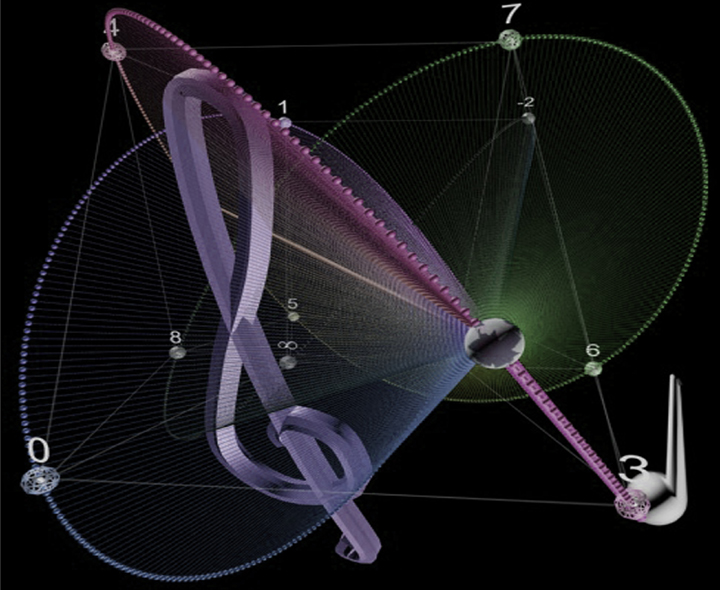
You arrive in a hall that is quiet but alive.
The architecture is grand, the kind that asks you to slow down. High ceilings. Soft, diffuse light. Along the walls, fourteen doors — each one a different color, each one leading somewhere the eye cannot quite predict from the threshold. Above each door, a name: Newton’s Circle. The Tonnetz. The Torus. Planet 4D. The Geode. The Cube Dance. And nine more beyond those.
From somewhere inside the building, you hear Shepard tones drifting through the air — sounds that rise and fall without ever arriving, looping through pitch space the way a spiral staircase loops through a building. There is no top, no bottom. Only the turning.
This is the Museum Hall. The entry point of the Mathemusical Virtual Museum.
Near the door to Scene 5, in a quiet corner, you find a memorial. Hand-drawn diagrams under glass — the Cube Dance, sketched on paper by Jack Douthett, who first imagined it. He is gone now. The drawings remain.
Stand still for a moment. Look at the fourteen doors. You do not need to enter all of them. You do not need a plan. Choose the one that calls to you — the brightest color, the most mysterious name, the door you have already half-opened in your mind.
Every room in this museum was built to be walked through. Some will take two minutes. Some will take two hours. All of them are real — the geometry is real, the music is real, the mathematics behind them has been studied for decades. You are not entering a simulation of science. You are entering science itself, made walkable.
Go when you are ready.
The Museum Hall is Scene 0 — the starting point and the home base of the Mathemusical Virtual Museum (MmvM). Every visit begins here. Every escape menu returns here. It is a transit space, a welcome, and a map.
What is MmvM?
The Mathemusical Virtual Museum is an interactive virtual reality environment built to make mathematical music theory tangible. Its fourteen scenes are three-dimensional realizations of abstract mathematical structures — spaces, graphs, surfaces, and higher-dimensional objects that mathematicians and music theorists use to describe the relationships between notes, chords, and keys.
The museum runs in two modes: in VR (on a headset such as the Meta Quest), you walk and fly through the rooms with your body; on a PC, you navigate with keyboard and mouse. Both modes are fully functional. VR gives the most immersive experience; PC gives the most comfortable working environment for extended study.
The museum was created by Gilles Baroin, a researcher and visual artist working at the intersection of mathematics, music, and spatial representation. It grew from a single experiment — porting his Planet-4D model into VR — into a collaborative project involving more than a dozen researchers from across the world.
The fourteen scenes at a glance
The scenes are numbered 1 through 14. Scene 0 (this hall) is the entry. Scene 9 is still in development. Here is what you will find behind each door:
- Scene 1 — Newton’s Circle. The twelve pitch classes arranged on a circle, colored with Isaac Newton’s chromatic system. The simplest and oldest structure in the museum.
- Scene 2 — The Tonnetz. The infinite lattice of fifths and thirds that Euler and Riemann used to map harmonic relationships, rendered as a flat surface you can walk across.
- Scene 3 — Torus of Thirds. The Tonnetz wrapped into a torus — a mathematical surface with no edges, where every path eventually loops back to where it started.
- Scene 4 — Planet 4D. Twelve notes on the surface of a four-dimensional hypersphere, animated to reveal the symmetries of tonal harmony.
- Scene 5 — Jack Douthett Memorial. A tribute to Jack Douthett (1942–2021), with his original hand-drawn Cube Dance diagrams and an interactive version of the graph he invented.
- Scene 6 — The Geode. A film theater showing research videos from around the world — animations, talks, and visualizations contributed by members of the broader community.
- Scene 7 — The Möbius Strip. A one-sided surface built from a musical transformation, where traveling the full length brings you back to the same notes in a different register.
- Scene 8 — The Cube Dance. Douthett and Steinbach’s parsimonious graph — twenty-eight objects (triads and the diminished seventh chord) connected by single-semitone voice leading — rendered as an interactive structure you can fly through.
- Scene 9 — Orbifolds. Coming soon.
- Scene 10 — Entangled Hyperspheres. Two S3 hyperspheres linked by a musical relationship, a collaboration between Baroin and Stéphane de Gérando.
- Scene 11 — Fourier Phases 4D. A visualization of the Discrete Fourier Transform applied to pitch-class sets, in four-dimensional space.
- Scene 12 — Franck Jedrzejewski Memorial. A tribute to Franck Jedrzejewski (1966–2022), mathematician and composer, with works and models from his research.
- Scene 13 — The Tonnetz in Higher Dimensions. Extensions of the Tonnetz to three and four dimensions, including generalizations developed by Baroin and Louis Bigo.
- Scene 14 — Planet Voices. A workshop for parsimonious voice leading — control up to four voices, watch their paths through harmonic space, and explore the geometry of smooth chord progressions.
How to move through the museum
In VR: You walk with your body. Press the A button on the right controller to open the menu in any scene. Some scenes allow flying; some keep you on the ground. Each scene’s menu explains its own controls.
On PC: You move with the keyboard (WASD or arrow keys) and mouse for camera direction. Press F1 to open the menu. Press Escape to return to the Museum Hall from any scene.
Sound throughout the museum uses spatial audio: each note radiates from its position in space, and a hearing radius around you controls what is loud and what is faint. Approach a source to hear it clearly; move away and it fades. The notes are rendered as Shepard tones — sounds with no fixed octave that cycle endlessly through pitch space, appropriate for pitch-class music.
Where to start
If you are completely new to the museum, Scene 1 (Newton’s Circle) is the natural beginning. It is the simplest structure — twelve colored spheres, one pitch class each — and it introduces the spatial-audio and color systems used throughout the rest of the museum. From there, Scene 2 (Tonnetz) and Scene 3 (Torus) build gently toward more complex topology. Scene 4 (Planet 4D) is the heart of Baroin’s own research. Scene 14 (Planet Voices) is the most interactive room for exploring harmony by hand.
If you are a researcher, you can enter any scene directly. Each has an independent manual at three reading levels.
The Museum Hall is the conceptual as well as physical center of MmvM. Understanding why the museum takes the form it does requires stepping back from the individual scenes and asking: what is mathematical music theory, and why does it produce virtual museums?
Mathematics and music as spatial disciplines
The connection between music and mathematics is older than either discipline as a formal science. Pythagoras identified the integer ratios underlying consonant intervals in the sixth century BCE. Euler constructed the first lattice representation of pitch relationships — the Tonnetz — in 1739. By the nineteenth century, Hugo Riemann had developed neo-Riemannian theory, a systematic account of the transformational relationships between major and minor triads, using the Tonnetz as its underlying space.
The key insight, made fully explicit only in the twentieth century, is that pitch relationships are not merely numerical: they are geometric. Notes occupy positions in a space. Intervals are distances. Chords are sets of points. Voice leading — the movement from one chord to another — is a path through that space. The smoothness of a harmonic progression, the sense of inevitability that a resolution creates, corresponds to the shortness of the path in a well-chosen geometry.
This is the central organizing principle of the museum. Every room is a different geometric space in which musical objects — pitch classes, intervals, chords, voice leadings — have been given position, distance, and topology. Walking through the rooms is not a metaphor for understanding the theory; it is understanding the theory, in the most direct form available to a spatial animal.
Why higher-dimensional geometry?
Many of the museum’s rooms involve geometry in three or four dimensions — tori, hyperspheres, orbifolds, tesseracts. This is not aesthetic exuberance. It is mathematical necessity.
The twelve pitch classes of Western music form a cyclic group Z12 under the operation of transposition. The natural space for this group is a circle — Newton’s Circle (Scene 1) and the chromatic clock underlying the Tonnetz (Scene 2). But as soon as we move from individual notes to chords, the dimensionality of the required space increases.
A pair of notes (a dyad) lives on a torus: the product of two circles, one for each voice’s pitch class. The torus has a twist — a Z2 symmetry that identifies the two voices (since {A, C} is the same dyad as {C, A}) — and the quotient is a Möbius strip (Scene 7). Three-note chords live on the orbifold T3/S3, a three-dimensional space with singularities at the symmetric chords (augmented triads, diminished seventh chords). These are not abstract constructions: they are the natural homes of the musical objects, and their geometric properties directly encode music-theoretic facts.
Dmitri Tymoczko’s work (2006, 2011) placed this correspondence on a rigorous footing: the orbifolds of voice-leading space are precisely the spaces in which parsimonious voice leading corresponds to short paths. Richard Cohn’s neo-Riemannian theory (1996, 2012) had already identified the key graphs — maximally smooth cycles, the Cube Dance — that describe the most efficient harmonic motions in tonal music. MmvM was built to make both frameworks inhabitable.
The Planet-4D research thread
Baroin’s own primary contribution to the field is the Planet-4D model (2000–2011), which places the twelve pitch classes on the surface of S3 — the three-sphere, the four-dimensional analogue of an ordinary sphere — in a configuration where every pair of notes is equidistant from all others with the same interval class. This is a unique embedding: no flat space and no lower-dimensional curved space admits it. S3 is the minimal space in which the full symmetry of Z12 can be realized geometrically.
The model was developed in Baroin’s PhD thesis (Université de Toulouse, 2011) and presented at MCM 2011. Its animated realization — the rotating 3D projection of the 4D object — became the basis for the Planet 4D scene (Scene 4) and for all subsequent work on the Hypersphere family (Scene 13, Scene 10).
The S3 framework also provides a unified setting for many of the museum’s other objects. The Tonnetz, when wrapped onto a torus, embeds naturally into S3 as the Clifford torus — a flat torus in four-dimensional space, one of the most symmetric surfaces known. The Cube Dance graph, when lifted to S3, reveals symmetries invisible in its flat representation. These connections are part of what makes the museum a coherent whole rather than a collection of independent scenes.
The museum as a research community
MmvM was not built alone. It emerged from more than two decades of interaction within the Society for Mathematics and Computation in Music (SMCM) — the international scholarly society that organizes the biennial MCM conferences and publishes the Journal of Mathematics and Music. The scenes dedicated to Douthett (Scene 5), Jedrzejewski (Scene 12), and the collaborative scenes (Planet Voices with Cohn, Scene 14; Entangled Hyperspheres with de Gérando, Scene 10) represent the human dimension of a genuinely collective intellectual project.
The museum is also a living artifact. New scenes will be added. The Geode (Scene 6) is designed to accept films and contributions from researchers who have not yet participated. Scenes that are currently stubs will be completed. The manual you are reading is part of this ongoing work.
Further reading
The Bibliography page of this manual (page 46578) collects the primary references for all fourteen scenes. Key starting points:
- Baroin, G. (2011). PhD thesis, Université de Toulouse. https://theses.hal.science/tel-00943407v1
- Tymoczko, D. (2011). A Geometry of Music. Oxford University Press.
- Cohn, R. (2012). Audacious Euphony. Oxford University Press.
- Euler, L. (1739). Tentamen novae theoriae musicae. St. Petersburg Academy of Sciences.
- Douthett, J., & Steinbach, P. (1998). Parsimonious Graphs. Journal of Music Theory, 42(2), 241–263.
- Cohn, R. (1996). Maximally Smooth Cycles. Music Analysis, 15(1), 9–40.
- Amiot, E., & Baroin, G. (2015). Old and New Isometries Between Pc Sets in the Planet-4D Model. Music Theory Online, 21(3).
Credits
- Gilles Baroin – Museum Hall design, overall museum architecture, Planet-4D research
- Jack Douthett (1942–2021) – Cube Dance memorial corner