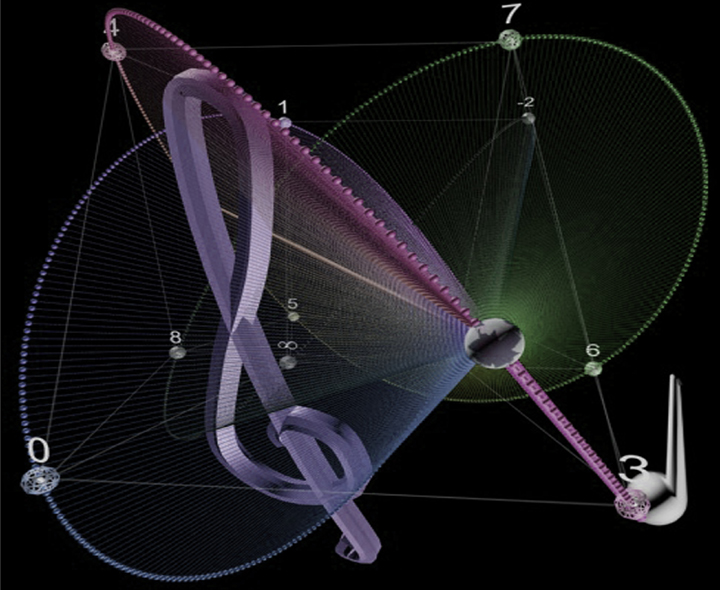
Look down. The floor is a map.
Colored symbols — spheres, cubes, diamonds, tetrahedra — arranged in a pattern that covers the ground beneath you. Each one is a chord. The lines between them are paths. Follow a path and the chord ahead of you begins to sing. Step back and it fades.
Here and there, white symbols mark special places — augmented chords, the turning points of the harmony, where all colors meet and none dominates.
This is the Cube Dance — drawn exactly as its creators Jack Douthett and Peter Steinbach first drew it, brought to life on the floor of a virtual room. You are not looking at a diagram. You are walking inside one.
You have already seen the man who drew this. Now walk his drawing.
In 1998, music theorists Jack Douthett and Peter Steinbach published a paper that changed how musicians think about harmonic relationships. They drew a graph connecting all 24 major and minor triads — and all 4 augmented triads — through what they called parsimonious voice-leading: chord changes where only one note moves, and it moves by just one or two semitones. They called the result the Cube Dance.
In this room, you are standing on that drawing.
The graph is projected on the floor, recreated with the Planet-4D ideographic symbols. Each node is a chord. Major triads are large and light-colored. Minor triads are large and dark-colored. And the four augmented triads — the special nodes where the harmony pivots — are white.
The white symbols are not arbitrary — they are mathematically inevitable. An augmented chord spans all three color families simultaneously. {C, E, G♯} contains a red note, a green note, and a blue note. No single color can claim it. White is the only honest answer. And the shape? Every neighbor of an augmented chord shares the same augmented family — so the shape is inherited naturally. A white sphere, a white tetrahedron, a white cube, a white diamond — four symbols, four augmented chords, each one the meeting point of everything around it.
You cannot move freely here. The graph has invisible walls — you follow the paths drawn on the floor. As you move along a path, the chords around you begin to sing. Each chord produces its own sound, built from the three pitch classes that compose it. The harmony comes to you as you walk.
Demo mode: press the demo button and a screen appears. It plays "The Gunner's Hamiltonian Dream" — Moreno Andreatta's Hamiltonian harmonization of Roger Waters' The Gunner's Dream (from Pink Floyd's The Final Cut), animated by Gilles Baroin. The song follows a Hamiltonian cycle on the Cube Dance — visiting all 28 chords exactly once before returning to the start. As the music plays, a treble clef moves across the floor in real time, tracing the path of the harmony. Watch the screen and the floor at the same time.
In this room: walk the paths slowly. Let the chords sing as you approach them. Then press demo and watch the Hamiltonian cycle unfold.
The Cube Dance model
The Cube Dance was introduced by Jack Douthett and Peter Steinbach in their 1998 paper "Parsimonious Graphs: A Study in Parsimony, Contextual Transformations, and Modes of Limited Transposition" (Journal of Music Theory, 42(2), 241–263). The graph connects all 24 major and minor triads and all 4 augmented triads through parsimonious voice-leading — chord transitions in which a single voice moves by one or two semitones.
The augmented triads serve as pivots: each connects to six major and minor triads, making it a hub of harmonic possibility. The graph reveals why the augmented triad functions as a harmonic chameleon in tonal music — it can resolve smoothly in multiple directions simultaneously.
The ideographic symbols — and the white augmented chords
The MmvM Cube Dance uses the Planet-4D ideographic system for all chord symbols. For augmented triads, the color dimension resolves in a mathematically forced way. An augmented triad {0,4,8} contains pitch classes from all three color families:
- Pitch class 0 (C) — Red family
- Pitch class 4 (E) — Green family
- Pitch class 8 (G♯) — Blue family
No single color can represent the chord. The solution is white — the visual mixture of all three colors. This is not a design choice but a mathematical consequence.
The shape is equally determined. All six neighbors of an augmented chord share the same augmented family — and therefore the same shape. The augmented chord inherits that shape naturally:
- {0, 4, 8} → white sphere
- {1, 5, 9} → white tetrahedron
- {2, 6, 10} → white cube
- {3, 7, 11} → white diamond
Navigation and sound
The visitor follows the paths of the graph — invisible walls enforce the structure. Moving along an edge is a chord change; arriving at a node is a chord. Each chord radiates its own sound from its three constituent pitch classes. No flight — flat ground throughout.
The Hamiltonian cycle — "The Gunner's Hamiltonian Dream"
A Hamiltonian cycle visits all 28 nodes exactly once before returning to the start. In demo mode the scene plays "The Gunner's Hamiltonian Dream" — a Hamiltonian harmonization by Moreno Andreatta of Roger Waters' The Gunner's Dream (Pink Floyd, The Final Cut, 1983), animated by Gilles Baroin. Presented at MCM 2019, Madrid. A treble clef traces the path on the floor in real time alongside the film.
Further reading
- Douthett, J., & Steinbach, P. (1998). Parsimonious Graphs. Journal of Music Theory, 42(2), 241–263.
- Baroin, G. (2011). PhD thesis, Université de Toulouse.
Credits
- Jack Douthett (1942–2021) — co-creator of the Cube Dance model
- Peter Steinbach — co-creator of the Cube Dance model
- Moreno Andreatta — "The Gunner's Hamiltonian Dream"
- Roger Waters / Pink Floyd — original song "The Gunner's Dream" (The Final Cut, 1983)