A screen awaits. Choose a film. And then — the room disappears.
If you chose a flat film, it plays on the screen like a cinema. If you chose a 360° film, the world around you becomes the motion picture. Above you, below you, behind you, in every direction — you are at the center of the image.
This is where the mathematical worlds of the museum become films — and where you can also visit mathemusical worlds that are not yet rooms in the museum.
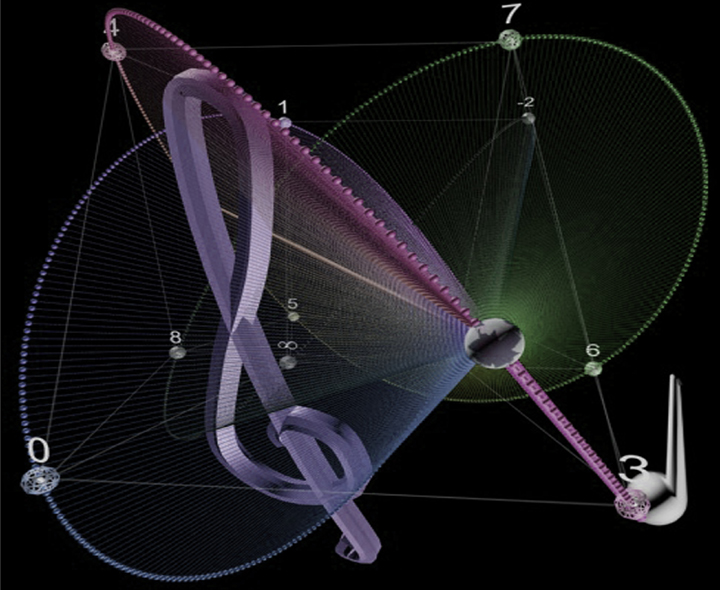
Watch Richard Cohn analyze a song through the Tonnetz. Watch the SpinnenTonnetz weave its spider web. Watch the Shadow Tonnetz, the Polarized Tonnetz, the Hypersphere of Temperaments — models that exist here only as films.
The Geode is still growing. New films will arrive. Films from other researchers, from other corners of the mathemusical world. Come back.
La Géode. The name pays tribute to the iconic spherical cinema in Paris — the famous mirror-finished dome at the Cité des Sciences et de l'Industrie, opened in 1985, where IMAX films are projected on a giant hemispherical screen. Here, the idea goes further: where the Paris Géode covers a hemisphere, MmvM covers the full sphere.
The Geode has two projection modes:
Flat mode — a film plays on a large screen in front of you. Traditional cinema. Works well on both VR headset and PC.
360° mode — the film surrounds you completely. Not just the ceiling, not just the front — every direction simultaneously. Above, below, left, right, behind you. You stand at the center of the world. On a VR headset, you turn your head and the film follows — full immersion, exactly as intended. On PC, you drag the mouse to pan around the sphere, like YouTube VR — it works, but the experience is designed for the headset.
To use the Geode: press A (VR) or F1 (PC) to open the menu. A simple file explorer appears. Select your film. The system detects automatically whether it is flat or 360° and projects accordingly. You do not need to move. You do not need to configure anything.
What is available:
The Geode is a window into a wider mathemusical world than what is implemented as interactive VR scenes. Its films fall into three broad categories:
- Richard Cohn's films — his own visual essays and analyses for his forthcoming book Mathemusical Models of Pitch and Time (2027). Examples include Tonnetz analyses of popular songs and explorations of the Cube Dance and other models.
- Films of mathematical models that do not appear as interactive scenes in this museum — the SpinnenTonnetz (Spider's Web), the Shadow Tonnetz, the Polarized Tonnetz, and members of the extended Planet 4D family such as the Hypersphere of Temperaments, the Hypersphere of Spectra, and the Hypersphere of other Tonnetze. These models exist here as films only.
- Films from other researchers and artists — independent compositions and interpretations from the broader mathemusical community, including pieces dedicated to pi and other mathematical objects.
Each film credits its authors directly. The films are produced by Gilles Baroin in collaboration with researchers and artists in the mathemusical community.
What is coming: The Geode is a platform, not a finished room. Pedagogical films are in development. Links to academic publications and films from other researchers will be added. Subtitles in multiple languages are planned.
In this room: open the menu. Browse. Choose a film. Let the mathematics come to you.
The name and concept
La Géode takes its name from the iconic spherical cinema at the Cité des Sciences et de l'Industrie in Paris, opened in 1985. The Paris Géode projects on a hemispherical screen — approximately 2π steradians, the upper half of the sphere. The MmvM Geode goes further: 4π steradians, the complete solid angle, every direction simultaneously.
Two projection modes
Flat mode — standard video on a planar screen. Optimal on both platforms.
360° mode — full spherical projection (4π steradians)
The films are produced inside Unity using six cameras, each pointing in one of the six orthogonal directions: front, back, left, right, up, down. The six images are captured simultaneously and assembled into a full equirectangular 360° video. Unity's Skybox system maps this onto the inner surface of a sphere surrounding the viewer.
VR headset: head tracking maps directly to the sphere. Turn your head and see a different part of the film. Full immersion — the intended experience.
PC: equivalent to YouTube VR on a flat monitor. Mouse drag to pan. Functional but not immersive. For 360° content, the VR headset is strongly recommended.
The role of the Geode
The Geode serves three purposes:
First, it presents mathemusical models that are not implemented as interactive scenes. The cost of implementing a model as a full interactive VR scene is high; many beautiful and valuable models exist only as films. The SpinnenTonnetz, the Shadow Tonnetz, the Polarized Tonnetz, the Hypersphere of Temperaments, and others fall into this category. The Geode is where these models live.
Second, it hosts Richard Cohn's visual essays for Mathemusical Models of Pitch and Time (2027). These films illustrate and analyze specific musical works through the lens of various models.
Third, it is a community platform — films from other researchers and artists, independent compositions, alternative interpretations. The Geode is not curated to a single voice. It is open.
Future development
- Pedagogical films — structured explanations of each scene's mathematics. Major project in development.
- Academic publication links — direct access to papers and proceedings.
- Films from other researchers — the Geode is a community venue.
- Web streaming — direct online streaming, no local storage required.
- Subtitles — multilingual, subject to production time.
- User films — add your own flat or 360° films via the file explorer.
Further reading
- Cohn, R. (forthcoming 2027). Mathemusical Models of Pitch and Time.
Credits
Each film carries its own credits. Films produced by Gilles Baroin in collaboration with researchers and artists in the mathemusical community.