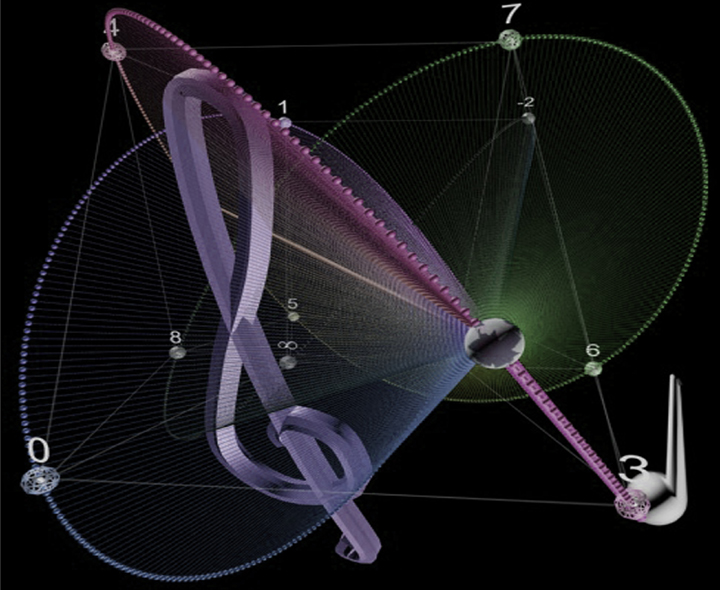
The Möbius strip. A strip of paper, a half-twist, a piece of tape — and suddenly the rules change. One surface. One edge. Walk along it and you end up where you started, having been on both sides without ever crossing an edge.
Every child has made one. But no one has ever been the ant.
Until now.
Around you, a giant ribbon of color loops through space. Twelve colored spheres — the twelve notes of the chromatic scale — travel along the strip. Walk among them on the ground and listen. Then find the H — the helicopter symbol — and click it.
You jump onto the strip and begin to move. The notes come toward you. The colors blur past. And somewhere along the way, without turning, without jumping, you will find yourself on the other side of the strip.
One surface. One edge. Enjoy the ride.
The Möbius strip is one of those timeless curiosities that never stops surprising. Take a strip of paper, give it a half-twist, and join the ends with tape. Cut it down the middle — and instead of two separate rings, you get one longer loop. Walk an ant along the surface in a straight line — it returns to its starting point having traveled what appears to be both sides, without ever lifting its feet or crossing an edge.
This scene was born from a simple desire: to be that ant. To feel the Möbius strip from the inside, in virtual reality, with music.
The twelve chromatic pitch classes are placed as colored spheres along the strip, each in its Newton color — the same system as Scene 1. Stand on the ground in the center and the strip loops around you. Walk and listen — the notes sing as you approach them, the hearing radius working as always.
When you are ready, find the H symbol — the helicopter symbol, a large H in a circle — on the strip surface. Click it, or shoot it with your joystick. You jump onto the strip and begin moving along it automatically — counterclockwise, against the flow of the scale. The notes travel clockwise along the strip, C to C♯ to D and onward. Moving in the opposite direction, they come toward you one by one, the chromatic scale arriving in reverse. The strip curves through space around you.
Somewhere along the journey — without turning, without jumping — you will find yourself on the other side of the strip. The same surface. The same direction. A different perspective.
Click the H again to return to the ground.
The Möbius strip has fascinated music theorists for decades. Many researchers have found that it captures something essential about how musical motion wraps around itself. This scene is the simplest possible version: one voice, twelve notes, one strip. A film in the Geode (Scene 6) shows what happens when you add a second voice. Scene 10 goes further still.
In this room: walk the ground first. Listen to the notes. Then click the H and ride the strip.
The Möbius strip — topology
The Möbius strip is a compact non-orientable surface with boundary — a two-dimensional manifold that cannot be given a consistent orientation. Constructed by identifying the two ends of a rectangular strip with a single half-twist (180° rotation). Its defining properties:
- One side — a path along the center traverses the full length and returns to the starting point, having visited both apparent faces.
- One edge — the boundary is a single closed curve.
- Non-orientability — no consistent global orientation can be defined.
The orientable double cover of the Möbius strip is a cylinder. One full traversal = half a circuit of the cylinder. Two full traversals return the traveler to original position and orientation.
The Möbius strip in music theory
Many researchers in mathematical music theory have identified the Möbius strip as the natural topology for two-voice chord spaces, interval cycles, and related structures. Its non-orientability mirrors certain musical symmetries — the flip corresponds to voice exchanges, inversions, and the relationship between ascending and descending intervals.
This scene presents the simplest possible musical Möbius strip: one voice, twelve chromatic pitch classes in order. The concept was developed by Gilles Baroin in conversation with Emmanuel Amiot.
The scene — implementation
The twelve pitch classes are placed as single spheres (quarks) at equally spaced positions around the Möbius strip, each carrying its Newton color. The strip is a large structure surrounding the visitor's ground position.
Ground mode: the visitor stands in the center. The strip loops around them. Spatial sound — each sphere radiates its pitch-class Shepard tone. The hearing radius controls what is audible, identical to Newton's Circle.
Strip mode: the H symbol (helicopter symbol — large H in a circle) toggles between ground and strip. Click it or shoot it with the joystick. The visitor is attached to the strip surface and moves counterclockwise automatically. The notes travel clockwise — C, C♯, D, and so on — so the visitor moves against the flow of the chromatic scale. The notes arrive one by one in reverse chromatic order. Click H again to return to the ground.
The ant's journey — mathematical note
The notes travel clockwise along the strip: C → C♯ → D → … → B → C. The visitor travels counterclockwise. After one full traversal of the strip's length, the visitor returns to the starting point — now on the other side of the strip, still moving in the same direction. A second full traversal returns them to the original orientation. The complete journey covers the orientable double cover — topologically a cylinder.
The Möbius strip as introduction
This scene is intentionally simple — the experiential entry point to a family of ideas. The Geode (Scene 6) contains a film showing parallel fifths moving along a Möbius strip — a two-voice illustration of the same topology. Scene 10 (Fourier Phases 4D) brings the full mathematical treatment with Emmanuel Amiot.
Further reading
- Baroin, G. (2011). PhD thesis, Université de Toulouse.
Credits
- Emmanuel Amiot (Université de Perpignan, LAMPS) — co-concept of the scene