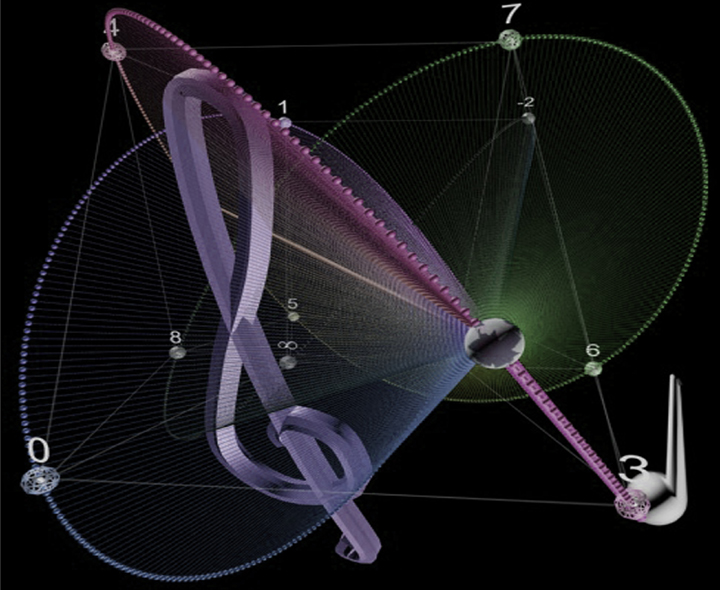
A surface covered in colored dots — hundreds of small spheres, each one a chord, scattered across a torus that slowly turns before you.
Every dot has a precise address in harmonic space. Move the compass and you travel across the surface, the dots drifting past. Change your speed. Change your direction. The harmonic landscape scrolls by like a slowly turning globe.
Then switch the surface. The same dots — the same chords — reproject onto a flat plane. Then onto a hypersphere. Then onto a Möbius strip. Then a Roman surface.
Beware of the Klein bottle. Once you have seen it, you will be a prisoner — you will never know if you are in or out.
This is what harmony looks like from the outside. Every chord in its mathematically correct position. A universe of sound made visible.
Every chord has a hidden mathematical fingerprint. Apply the Discrete Fourier Transform to its pitch classes and you get a set of complex numbers — each one capturing a different quality of the chord's sound. The third coefficient measures how octatonic or diminished the chord feels. The fifth measures how diatonic or tonal it feels. Together, these two values — their phases φ₃ and φ₅ — give every chord a unique address: two coordinates that place it precisely in a two-dimensional harmonic space.
This scene makes that space visible. Every chord is a small colored sphere — all the same size, each colored by chord type. Minor triads in one color, major triads in another, dyads of fifths, semitones, dominant sevenths — each category in its own color, scattered across the surface at their exact (φ₃, φ₅) position. The mathematical work is by Emmanuel Amiot (Université de Perpignan) and Jason Yust (Boston University).
The scene starts as a torus, set in motion along the direction that best shows the harmonic structure. You navigate it like a pilot — a compass controls your heading in the harmonic plane, and you adjust your speed. Different chord types can be toggled on or off. Each combination reveals a different layer of harmonic geometry.
Demo mode: press the button — it asks: What's on your mind? — and hear Ray Charles' Georgia on My Mind. The surface moves so that each chord of the song arrives at your fixed position as it plays. Ray Charles marks your spot. The harmony comes to you. The song was chosen for its title, its question, and its geography: the first showing of this scene was at MCM 2022 in Atlanta, Georgia. The choice made itself.
But the most striking feature is the model switch. Because every chord needs only two coordinates, the same harmonic data can be projected onto any two-dimensional surface: the torus, a flat plane, the hypersphere, the Möbius strip, the Klein bottle, or the Roman surface. The chords never move — only the shape of the space changes.
Beware of the Klein bottle. Once you have seen it, you will be a prisoner — you will never know if you are in or out.
Approach the spheres and hear them — spatial sound, hearing radius as always.
In this room: set the torus turning. Toggle chord types. Press the button and let Ray Charles ask his question. Then switch surfaces and watch the same harmony reshape itself.
The Discrete Fourier Transform of pitch-class sets
For a pitch-class set A ⊆ Z₁₂:
F_k(A) = Σ_{n ∈ A} e^(2πi·k·n/12)
- φ₃ — phase of F₃ — measures octatonic/diminished quality.
- φ₅ — phase of F₅ — measures diatonic/tonal quality.
Together (φ₃, φ₅) give every chord a unique address in Fourier phase space. Theory: Emmanuel Amiot (Music Through Fourier Space, 2016). Musical applications: Jason Yust (Journal of Music Theory, 2015).
The six surfaces
1. Plane — flat grid, scrolling in X and Y. Most direct. 2. Möbius strip — non-orientable, connects to Scene 8. 3. Torus — default. Both coordinates cyclic mod 2π — topologically natural. 4. Hypersphere — rotates along α and θ. Same geometry as Scene 4 (Planet 4D). 5. Klein bottle — non-orientable closed surface. No inside or outside. 6. Roman surface — self-intersecting realization of the real projective plane in 3D.
Navigation
Compass heading controls the ratio of φ₃/φ₅ motion:
dα/dt = groundSpeed · cos(heading) dθ/dt = groundSpeed · sin(heading)
Starts at heading 53° — the 3:5 ratio direction. Speed and heading adjustable in real time. Stop/Start button pauses and resumes.
The Ray Charles demo
Georgia on My Mind plays, driven by chord analysis. The surface moves — rotating or scrolling — so that each chord of the song arrives at the fixed user spot, marked by the Ray Charles symbol. The harmony comes to the visitor. Same mechanism as Scene 3 (Torus) and Scene 4 (Planet 4D). The button reads: What's on your mind? The premiere was at MCM 2022, Atlanta, Georgia.
Chord types and coloring
All spheres same size. Color identifies chord type. Twelve toggleable categories: singles, dyads (perfect fifth, semitone, third), triads (minor, major, quartal, six-nine, minor sixth, major sixth, minor seventh, dominant seventh).
Sound
Spatial — hearing radius, identical to Newton and Tonnetz.
Further reading
- Amiot, E. (2016). Music Through Fourier Space. Springer.
- Yust, J. (2015). Schubert's Harmonic Language and Fourier Phase Space. Journal of Music Theory 59(1), 121–181.
- Baroin, G. (2011). PhD thesis, Université de Toulouse.
Credits
- Emmanuel Amiot (Université de Perpignan, LAMPS) — DFT theory
- Jason Yust (Boston University) — Fourier phase space musical applications
- Ray Charles — Georgia on My Mind (demo song)