A Rubik's cube, waiting for you.
Each small square is a note. Each large face is a chord — whatever notes happen to be on that face at this moment. Reach for the triggers and rotate a face. The squares rearrange. The chord changes. The top face sings.
Scramble it. Listen to what you find. Notes can repeat on a face — chords can be clusters or intervals or unisons. Every configuration is a different sonic moment.
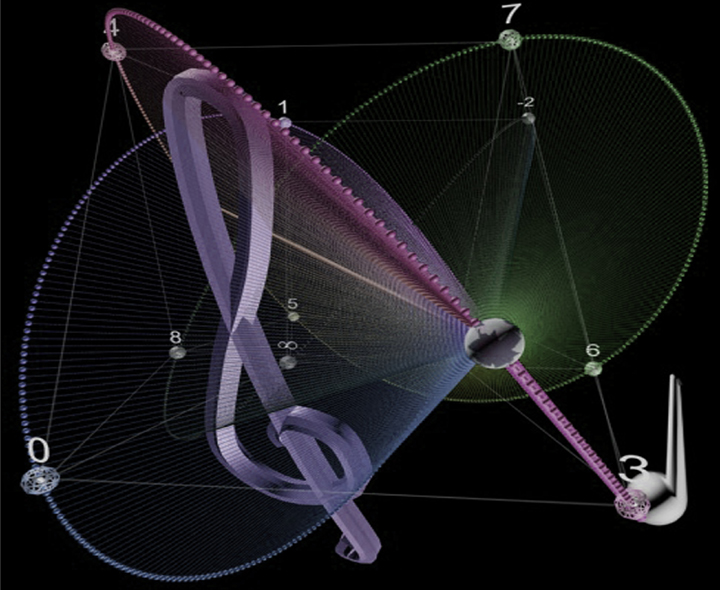
Look up: a display in the sky shows you exactly which notes are playing right now.
This is the CubeHarmonic — a musical instrument conceived by Maria Mannone. In the real world it is a physical cube with magnets, played at concerts with an orchestra. Here it is virtual. But the harmony is just as real.
In 2013, mathemusician Maria Mannone had an idea at IRCAM in Paris: what if a Rubik's cube could be a musical instrument?
The principle is simple. Each of the 54 small facets carries one note. Each of the 6 large faces carries the sound of its 9 facets — whatever notes happen to occupy that face at any given moment, including repetitions. As you rotate the cube, the facets move, the chords change. The top face always plays its current notes, using Shepard tones — the same cyclic, octave-free sounds used throughout this museum.
Here the goal is inverted. With a standard Rubik's cube, the aim is to solve it — to restore order. With the CubeHarmonic, the aim is the scrambling itself. Every twist is a harmonic event. Every configuration is a valid destination.
In the physical CubeHarmonic, the position of each facet is detected by magnetic 3D motion tracking technology developed at Tohoku University, Japan. The performer plays the cube live, with an orchestra. The same instrument can compose, improvise, and teach — and it allows visually impaired people to experience the Rubik's cube through sound instead of color.
In this installation, the cube is virtual. Use the VR triggers to rotate the faces. The top face always plays its current chord. A display in the sky shows the current notes in real time.
There is no right answer. No solved state to reach. Every configuration is a valid harmonic moment. Play it like a puzzle. Play it like an instrument. The cube does not judge.
In this room: rotate a face and listen. Scramble freely. Look up at the sky display to follow the notes.
The CubeHarmonic — origin and mathematical concept
The CubeHarmonic was conceived by mathemusician Maria Mannone in 2013 during her studies of music and combinatorics at IRCAM, Paris. It was first published under the name CubHarmonic (Mazzola, Mannone & Pang, 2016) and later refined as CubeHarmonic.
The instrument joins two mathematical traditions: combinatorics and the Tonnetz. The Rubik's cube is a physical embodiment of combinatorial permutations — every face rotation is a permutation of the 54 facets. The Tonnetz provides the musical interpretation of those permutations. Together they form an instrument where mathematical structure and harmonic structure are the same thing.
The Rubik's cube group
The group of all configurations of the 3×3×3 Rubik's cube has order 43,252,003,274,489,856,000 — approximately 4.3 × 10¹⁹. Each face rotation generates a cyclic subgroup; the full group is generated by composition of the six face moves. In the CubeHarmonic, each element of this group corresponds to a specific sonic state. Navigating the group is navigating a harmonic space whose dimension far exceeds what any conventional instrument can access.
The key inversion: while the goal of the Rubik's cube is to solve it (reach the identity element), the goal of the CubeHarmonic is the opposite — to scramble, to explore, to move away from the identity into the richness of the group.
Permutations in music history
The use of permutations to generate music has a long history — Musikalische Würfelspiele (musical dice games) associated with Haydn and Mozart, the ars combinatoria of Ramon Llull, Athanasius Kircher's Musurgia Universalis (1650). The CubeHarmonic places this tradition in the hands of the performer, making the permutation physical, tangible, and immediate.
The note assignment and initial chord
The 54 facets are assigned specific notes from the chromatic scale. The initial solved state presents six distinct harmonic faces — each with its own character, including repetitions. The top face begins with predominantly F notes, mixed with A, D, and Eb. The front face contains multiple C notes with F♯ and A. Scrambling mixes these characters across all faces simultaneously. The specific assignment was designed by Maria Mannone to create musically interesting faces in the solved state and rich harmonic variation through scrambling.
The Tonnetz connection
Rotating a face of the cube is like moving along an edge of the Tonnetz — changing one chord to an adjacent one. The permutation group of the cube and the transformation group of the Tonnetz share a common mathematical substrate. This connection is explicit in Mannone's 2018 paper.
The virtual implementation
VR triggers rotate faces. Top face plays Shepard tones of current notes. Sky display shows note names in real time. Stereo sound. Fly locomotion. A random scramble button applies a sequence of random moves and then animates the cube back to the solved state — the full harmonic journey played in reverse, step by step.
Extensions
In 2022, Mannone and collaborators extended the concept to four dimensions with the HyperCubeHarmonic (MCM 2022, LNCS 13267) — applying the same principle to a 4D hypercube. The mathematical extension is elegant; its implementation in virtual reality for a general audience remains a longer-term research horizon.
Key publications
- Mannone et al. (2018). CubeHarmonic: A New Interface from a Magnetic 3D Motion Tracking System to Music Performance. NIME 2018, pp. 350–351.
- Mannone et al. (2019). CubeHarmonic: A New Musical Instrument Based on Rubik's Cube with Embedded Motion Sensor. ACM SIGGRAPH 2019.
- Mazzola, Mannone & Pang (2016). Cool Math for Hot Music. Springer.
Credits
- Maria Mannone — CubeHarmonic concept (IRCAM, 2013)
- E. Kitamura, J. Huang, R. Sugawara, Y. Kitamura (Tohoku University) — physical instrument technology