Welcome
Music has a hidden geometry. Notes that sound close together really do sit close together in mathematical space. Chords that resolve naturally trace short, smooth paths. Composers have always known this in their hands and ears. Mathematicians have spent two centuries mapping it.
This museum lets you walk inside the maps.
You will find harmonic spaces you can fly through. Instruments you can play. A theater of films from researchers around the world. Tributes to friends who shaped the field. Some rooms are simple and playful. Some are mathematically rich. All of them are real geometric structures that musicians and mathematicians have studied for decades — now turned into spaces you can enter.
You do not need to know any mathematics to enjoy the museum. You do not need to read music. Just walk in and let the colors, sounds, and shapes work on you.
How to Read This Manual
Every scene in this museum is described at three levels:
- ENJOY — the short, poetic version. What you see, what to try, what makes it beautiful. Two minutes.
- UNDERSTAND — the curious-visitor version. What the room actually is, where the ideas come from, how to play with it. Five minutes.
- DEEPEN — the researcher version. The mathematics, the history, the references. As long as you need.
Inside the museum, each scene has three pictogram buttons — child, musician, researcher. Press one and the corresponding voice reads the text aloud. Choose the level that fits your curiosity. You can switch any time.
How to Move and Listen
The museum works in two ways:
In VR (a headset like the Meta Quest), you walk through the rooms with your body. Press the A button on the right controller to open the menu in any scene. Some scenes let you fly. Some keep you on the ground. Each scene explains its own controls.
On a PC, you move with the keyboard and mouse. Press F1 to open the menu. Press Escape to return to the Museum Hall.
The sounds in the museum follow you. Most rooms use spatial audio — notes radiate from their position in space. A hearing radius around you controls what is loud and what is faint. Approach a note to hear it clearly. Walk away and it fades.
You will hear Shepard tones throughout. These are sounds that cycle endlessly through pitch without ever arriving at a higher or lower octave. They are the natural voice of pitch-class music — the kind of music that lives on a circle, where going around far enough brings you back where you started.
Who Made This
The museum is the work of a community I love being part of — colleagues and friends from around the world, gathered around the Society for Mathematics and Computation in Music. Some of us see each other once a year at conferences. Some collaborate for years across continents. We are mathemusicians who actually like each other. The atmosphere is unusually warm.
Each room of the museum credits its contributors directly. The films in the Geode carry their own credits. The memorials honor friends we have lost. None of this is solo work. All of it is collective.
How It Started
I am not the best mathematician in this community, and not the best musician either. What I do well is bring mathematical music to life — animations, images, films. People know me for the videos.
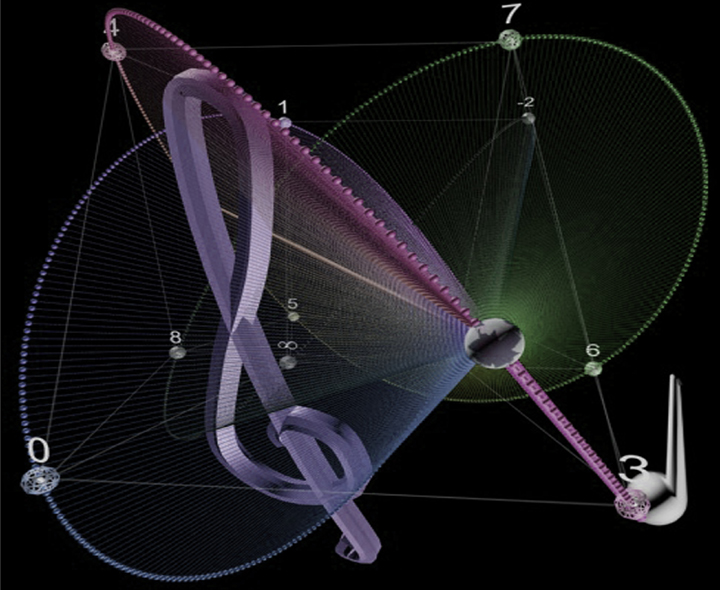
A few years ago, between jobs, I started learning Unity to make myself useful in a new way. As an experiment, I tried porting my Planet-4D model into virtual reality. It worked. Then I added another model. Then another. Each time I built something new, I reached out to colleagues and friends to ask what they thought, what could be improved, what I should try next. New collaborations started. Old ones deepened.
The museum is what grew from that.
What Is Still Growing
The museum is alive. Some rooms are richer than others. Some are still being built. The Geode in particular is designed to keep filling up — with films of new models, with pedagogical material, with contributions from researchers I have not even met yet.
If you visit once and find a room that feels thin, come back next year. There will be more.
Welcome.
— Gilles Baroin www.MatheMusic.net