Under construction — not yet public. This page is shared for review only and is not linked from any menu.
Visual identity for the 2027 mathemusical event at the Isaac Newton Institute, Cambridge.
Designed by Gilles Baroin, PhD — Université de Toulouse · MatheMusic.net
Summary — the key points
- A correspondence, not a proportion. Newton saw a correspondence between colour and music — and, beyond them, between light, matter, harmony and the cosmos: one ordered world. The mark makes that vision visible and carries it into contemporary research.
- The hinge is the word chromatic. It belongs to both worlds at once — the chromatic of the spectrum and the chromatic scale of twelve semitones (same root, khrōma, colour). Newton’s circle sits exactly where the two meanings meet; the link is in the language itself.
- The outer ring is Newton’s 1704 wheel, planetary and alchemical glyphs kept by intention — the world of the last sorcerer, and what makes this unmistakably Newton’s diagram rather than a generic colour wheel.
- The twelve colours are a documented system, reconstructed with the painter Charles Giulioli and published in the designer’s 2011 thesis. They are a notation, constant across every model.
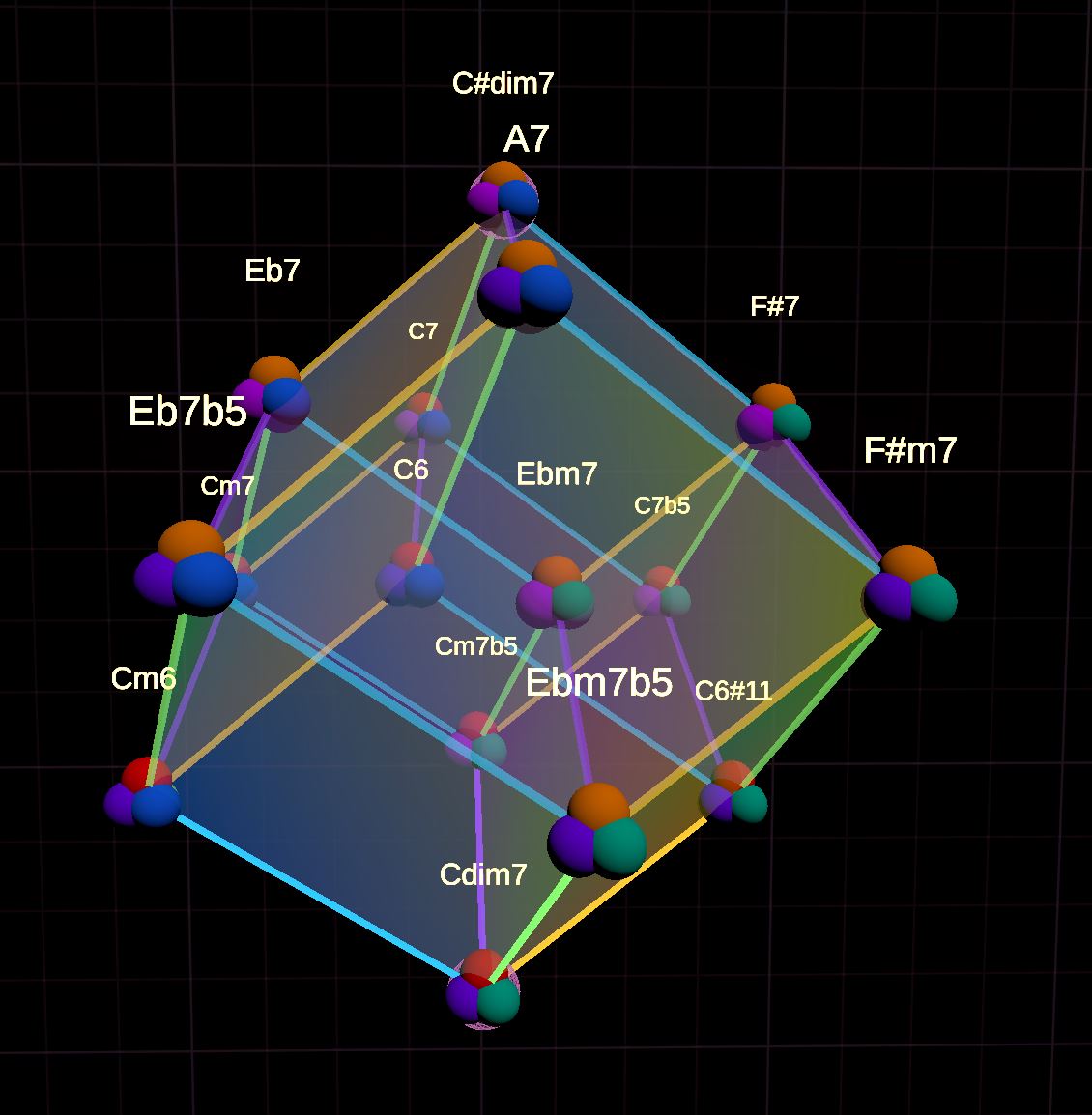
- At the centre, the octatonic tesseract — chosen because every mathematician knows the tesseract. The model is Douthett & Steinbach’s; the designer’s contribution is the tetraquark, where one moving voice changes exactly one colour and three are conserved — voice-leading as a conservation law.
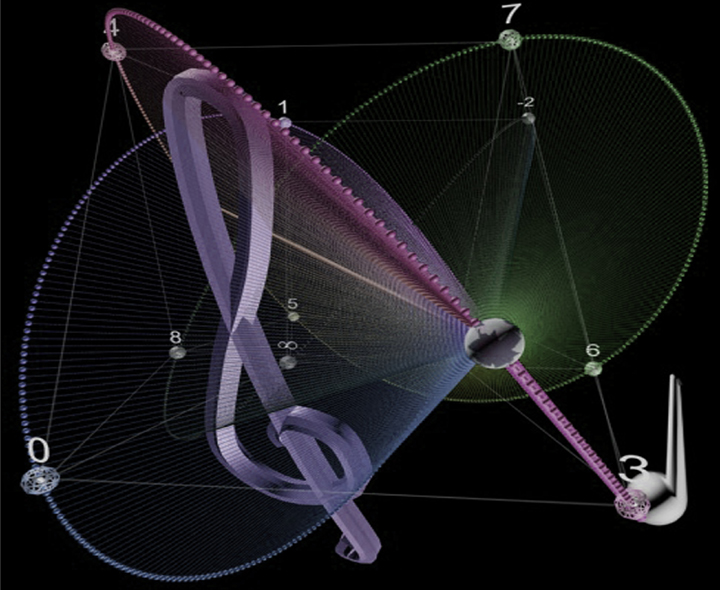
- A treble clef at its own pitch G, echoing the integral’s shape but deliberately not an integral (that is Leibniz’s). Newton’s own calculus, the fluxion, sits at the centre.
- A working system under Creative Commons, credited at each use.
Three honest correspondences are layered in the mark: chromatic (colour and pitch), the clef resting on its true G, and the fluxion as Newton’s real calculus.
In one line
Newton saw a correspondence between colour and music. The very word chromatic holds both — the chromatic of the spectrum and the chromatic scale of the twelve semitones — and his circle sits exactly where the two meanings meet.
The starting point
The brief was to build the identity around Newton’s chromatic circle. For me this was not a borrowed motif but the foundation of my own work: Newton’s circle, and the twelve colours I derived from it, sit at the origin of every model I have built. The central idea of the event was already the central idea of my research, so the design only had to make it visible. From there, every decision served a single idea — that colour and music are one correspondence — expressed as economically as possible.
The outer ring — Newton’s 1704 wheel
The mark is enclosed by Isaac Newton’s chromatic circle. In his Opticks (1704), Newton arranged the colours of the spectrum around a circle and set them in relation to the notes of the scale. The circle is chromatic in both senses at once: a wheel of colours and a wheel of pitches. That double meaning is not a pun the design imposes — it is built into the word, and into Newton’s conviction that light, colour, sound and harmony belonged to one ordered world.
The note-letters sit at Newton’s true angles, so the steps are not mechanically even. The planetary and alchemical glyphs around the ring are kept by intention, not nostalgia: they place the mark in Newton’s own world — optics, music, alchemy and the harmony of the spheres as a single inquiry — the Newton of The Last Sorcerer. They are also what make this unmistakably Newton’s 1704 diagram rather than a generic colour wheel. The ring is a clean redraw rather than the original engraving, which keeps Newton’s logic while letting the mark scale, reverse, and sit quietly beside an institutional brand.

The twelve colours — a documented system
The colours are the heart of the identity, and they are neither arbitrary nor decorative. Newton’s Opticks defined a set of spectral colours for the notes; the full twelve-colour extension — one colour for each chromatic pitch — was reconstructed in collaboration with the painter Charles Giulioli, and its official values were published in my doctoral thesis (Université de Toulouse, 2011).
They function as a notation. Each pitch class keeps the same colour in every model — and across the whole Mathemusical Virtual Museum, the same twelve colours return in Newton’s Circle, the Tonnetz, the Möbius strip, the orbifold of voice-leading and the octatonic tesseract. A red sphere is the same pitch class wherever it appears. That consistency is precisely what makes a single coherent identity possible: the colour system is the constant thread of the work, and so it is the spine of the mark.
The centre — the octatonic tesseract
At the centre sits a four-dimensional figure: a tesseract, the hypercube. The choice of this object is deliberate. The tesseract is the one four-dimensional form nearly every mathematician already recognises, so the mark meets its audience on familiar ground and pays quiet tribute to the shared mathematical culture the event belongs to. The four-dimensional idea is advanced; the figure that carries it is welcoming.
The model shown is the octatonic tesseract, a space of four-note chords linked by their smoothest connections. Each chord is drawn as a tetraquark — four spheres, one per voice, each in its Newton colour. This is the contribution I bring to the model: moving from one chord to a neighbour shifts a single voice, so exactly one colour changes while three are conserved. Voice-leading becomes visible, and countable, as colour — a conservation law in the spirit of Noether’s theorem, where a symmetry appears as something preserved. The same tesseract can be explored in virtual reality in the Mathemusical Virtual Museum, and will be shown at the exhibition.
Set inside Newton’s 1704 ring, the figure lets the whole read as past meeting present: the historical circle on the outside, a contemporary model held in its core.
The treble clef and the fluxion
To the right, a treble clef sits exactly at the G position of Newton’s circle. The treble clef is historically the symbol that fixes the pitch G — so here it rests on its own true note, naming the pitch it sits upon. It echoes the elongated-S shape of an integral sign, but it is deliberately not an integral: the integral (∫) is Leibniz’s notation, and this is a Newton mark. Newton’s own calculus is the fluxion — the dotted notation (ẋ) — which sits at the very centre. The clef brings the music and names its own pitch; the fluxion supplies the specifically-Newtonian signature, correctly attributed.
Craft and palette
The craft is restrained so the colour can speak: a quiet ground, gold for the structure and the wordmark, and the twelve saturated Newton colours as the only chromatic voice. The typography pairs a historical, engraving-era serif for the voice of the identity with a clean structured sans for everything that must stay neutral and legible.
The result is a working system, not a single picture: it holds on light, charcoal and black grounds, reduces to a one-colour mark and to a favicon, and travels cleanly across the web page, posters, dépliants, slides and social media.
Licence
The identity is delivered to the Isaac Newton Institute under Creative Commons, credited to the designer at each use.
Bibliography
- Newton, I. (1704). Opticks. London.
- Baroin, G. (2011). PhD thesis, Université de Toulouse. https://theses.hal.science/tel-00943407v1
- Baroin, G. Mathemusical Virtual Museum (MmvM) — interactive virtual-reality museum. www.MatheMusic.net
- White, M. (1997). Isaac Newton: The Last Sorcerer. Fourth Estate.
- Douthett, J., & Steinbach, P. (1998). Parsimonious Graphs. Journal of Music Theory, 42(2), 241–263.
- Cohn, R. (2012). Audacious Euphony. Oxford University Press.
- Tymoczko, D. (2011). A Geometry of Music. Oxford University Press.
- Hook, J. (2023). Exploring Musical Spaces. Oxford University Press.
Credits
- Isaac Newton (1704) — the original colour–music correspondence
- Charles Giulioli — co-creator, with Gilles Baroin, of the twelve-colour extension of Newton’s system
- Jack Douthett & Peter Steinbach — originators of the octatonic-tesseract model (the 4-Cube Trio, 1998)
- Richard Cohn, Dmitri Tymoczko, Julian Hook — study and development of seventh-chord voice-leading spaces
- Gilles Baroin, PhD — visual identity, the twelve-colour system, the tetraquark visualization, and the design
Visual identity by Gilles Baroin, PhD — Université de Toulouse · MatheMusic.net · Released under Creative Commons, credited at each use.